What your child practises
Saying the fear out loud, taking one small step, and having a helper or a “courage object”.
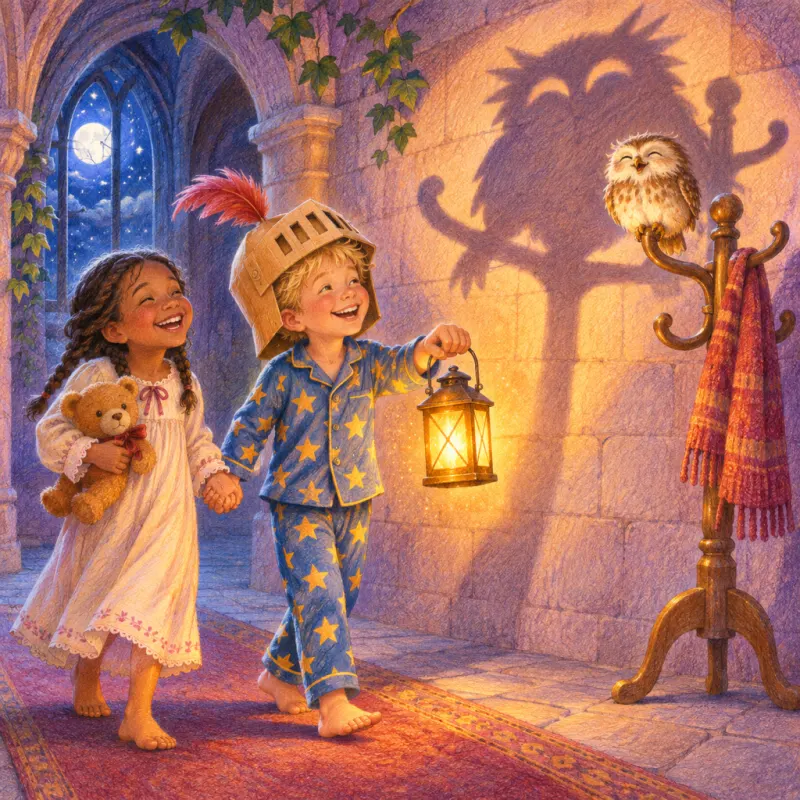
When the light comes on, the monster in the dark turns out to be funny, and the hero takes “three steps of courage”. The fear gets smaller but doesn’t vanish completely — honestly. The story doesn’t add new fears, and the tension is resolved within the same part of the story.
Five steps your child practises
Say the fear out loud
“I’m scared of the dark hallway.” Once it’s said, it gets smaller.
A courage object and a helper
A torch, a cuddly toy, someone who stays with you.
The smallest step
Not the whole hallway at once — just to the door first.
The next step
When the first one works, go a little further.
Be proud of trying
Being brave doesn’t mean not being scared — it means trying even when you are.
How the story shows it
The monster in the dark turns out to be something small or funny. We adjust the scariness to the child’s age — and we never introduce new fears.
- 1 · Discover
The hero avoids a dark corridor and can’t go on the expedition. A friend shows them her “three steps of courage”.
- 2 · Try
Your child picks the hero’s courage object and first step. With a lantern, the hero discovers what is casting the shadow.
- 3 · Teach
A younger creature is scared — the hero shows them how to take it bit by bit.
The last page: turning off the bedroom light for the first time — with a torch under the pillow.
By age
- Development
- Mostly scared by what looks scary (the dark, monsters, a character transforming); comforted more by action — light, a hug — than by explanations. Sparks & Cantor 1986
- In the story
- No tension and no scary scenes; the monster is funny from the start. A parent reads aloud.
- Development
- In one study, fears and scary dreams peaked at exactly 7–9 — so we pace suspense carefully. Muris et al. 2000
- In the story
- Handled with care: children of this age have lots of fears — the dark, animals, new places.
- Development
- Fear of imaginary creatures fades and worries grow — school, performance, the health of loved ones. Muris et al. 2000
- In the story
- Fear of tests, performing or failing; a step-by-step plan.
- Development
- Worries about what others will think; sensitivity to being judged. Somerville 2013
- In the story
- Fear of being judged by others; courage without lectures.
What we base this on
The approach
With everyday fears it helps to approach them in small steps (a courage ladder), to praise bravery and to express confidence (“it’s hard and you can do it”) rather than letting the child avoid everything. The story adjusts suspense to age, because fear can also come from information. Severe anxiety needs a professional.
The rating is about the approach, not about our comic — the comic itself has not yet been scientifically tested.
What the research says
Fears and scary dreams peaked around ages 7–9, and children most often attributed their fears to information — to what they had heard or seen, which includes stories.
Children aged 3–5 were frightened mainly by appearance (a character’s transformation), 9–11-year-olds more by the suspense before it — so for the youngest we don’t draw scary transformations.
For anxiety disorders, the treatment is cognitive behavioural therapy (CBT): after treatment 49.4% of children were in remission versus 17.8% on a waiting list; compared with usual care there was no clear difference.
In a clinical trial, the SPACE programme (parents gradually stop accommodating avoidance and express confidence) was not less effective than CBT; brief parent-led CBT with professional guidance is also being studied. This was professional treatment, not story reading.
What we don’t promise on this topic
That the comic treats anxiety. Severe or long-lasting anxiety needs a professional; the story is meant for everyday fears, and its effect has not yet been tested.
Key sources
- Muris, P., Merckelbach, H., Gadet, B., & Moulaert, V. (2000). Fears, worries, and scary dreams in 4- to 12-year-old children: Their content, developmental pattern, and origins. Journal of Clinical Child Psychology, 29(1), 43–52. doi.org/10.1207/s15374424jccp2901_5 abstract
- Sparks, G. G., & Cantor, J. (1986). Developmental differences in fright responses to a television program depicting a character transformation. Journal of Broadcasting & Electronic Media, 30(3), 309–323. doi.org/10.1080/08838158609386626 abstract
- James, A. C., Reardon, T., Soler, A., James, G., & Creswell, C. (2020). Cognitive behavioural therapy for anxiety disorders in children and adolescents. Cochrane Database of Systematic Reviews, 2020(11), CD013162. doi.org/10.1002/14651858.CD013162.pub2 abstract
- Lebowitz, E. R., Marin, C., Martino, A., Shimshoni, Y., & Silverman, W. K. (2020). Parent-based treatment as efficacious as CBT for childhood anxiety (SPACE). JAACAP, 59(3), 362–372. doi.org/10.1016/j.jaac.2019.02.014 metadata
- Thirlwall, K., Cooper, P. J., Karalus, J., Voysey, M., Willetts, L., & Creswell, C. (2013). Treatment of child anxiety disorders via guided parent-delivered CBT: RCT. British Journal of Psychiatry, 203(6), 436–444. doi.org/10.1192/bjp.bp.113.126698 metadata
- Creswell, C., et al. (2017). Clinical outcomes and cost-effectiveness of brief guided parent-delivered CBT and solution-focused brief therapy for treatment of childhood anxiety disorders: RCT. Lancet Psychiatry, 4(7), 529–539. doi.org/10.1016/S2215-0366(17)30149-9 metadata
- Somerville, L. H. (2013). The teenage brain: Sensitivity to social evaluation. Current Directions in Psychological Science, 22(2), 121–127. doi.org/10.1177/0963721413476512 metadata
- abstract abstract or full text read
- metadata bibliographic details verified
- institution official institutional document
Who prepared this and when
Written by the Ink & Brave editorial team from our evidence base (sources verified 8 November 2026, last updated 9 November 2026).
If you feel like it
- Don’t say “there’s nothing to be scared of” — try “I understand that you’re scared”.
- If your child wants, the courage object from the comic can live at home too.
When a comic isn’t enough
- The fear seriously limits your child (they can’t sleep, don’t want to go out or to school) or lasts a long time.
- After a frightening event, or with panic or severe anxiety, talk to a paediatrician or GP, or a child psychologist.
Need help right now? If someone is in danger, call your local emergency number — 112 in the EU, 999 in the UK, 911 in the US and Canada, 000 in Australia. Child and parent helplines by country
Frequently asked questions
Won’t the comic scare my child even more?
It isn’t horror. We adjust the tension to the child’s age, and the monster always turns out to be something small or funny.
Will the fear go away completely?
We don’t promise that. The comic helps your child practise small steps; fear can get smaller, but it may not go away completely.
Is it suitable for fear of school?
For ordinary nerves, yes. If your child is afraid of school because someone is hurting them, see the topic Telling a trusted adult and talk to the school.
Reading for parents
- Article in preparation Afraid of the dark: how to help without “there’s nothing to be scared of”
Personalised book: Fear and courage
A personalised book on this topic — a story for €9.90 (1 story · 16 pages) or a whole adventure for €24.90 (3 stories · 48 pages), as a storybook or a comic. A free drawing of the hero first.