
What your child practises
Noticing who is left out and inviting them in — or asking politely “Can I join in?” and coping when someone says no.
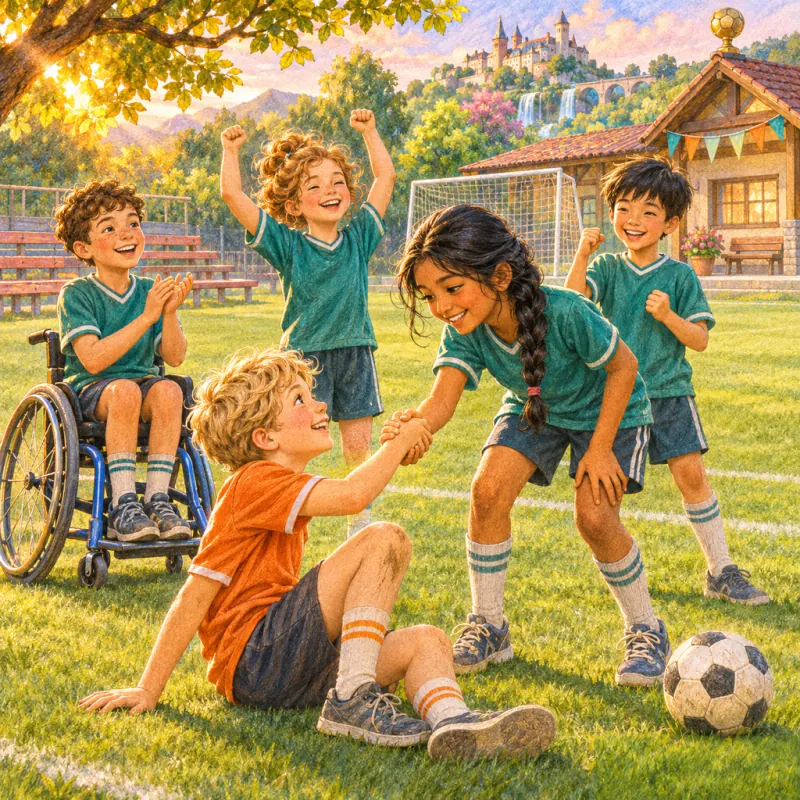
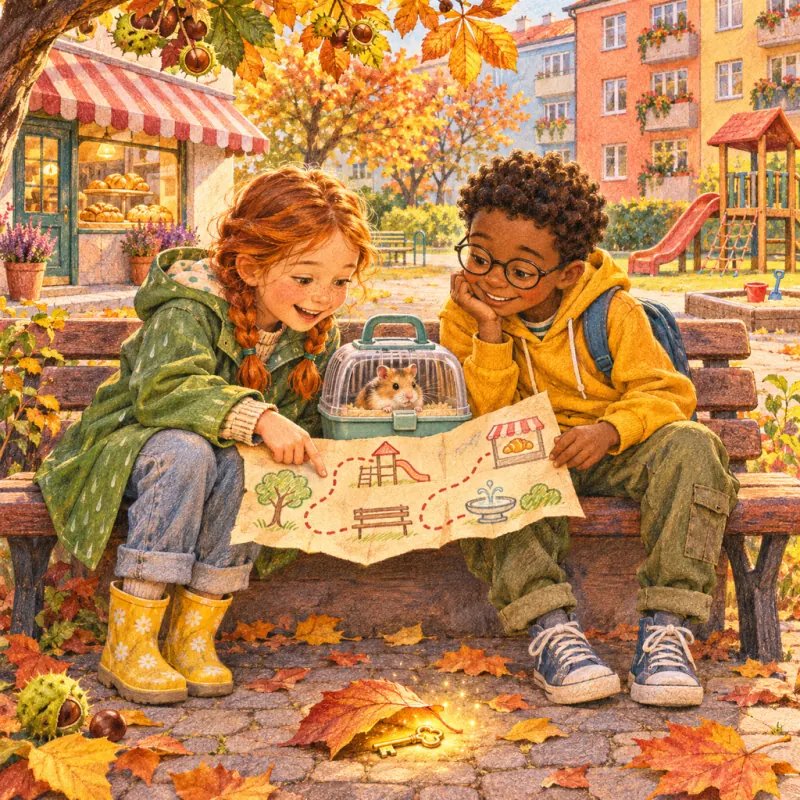
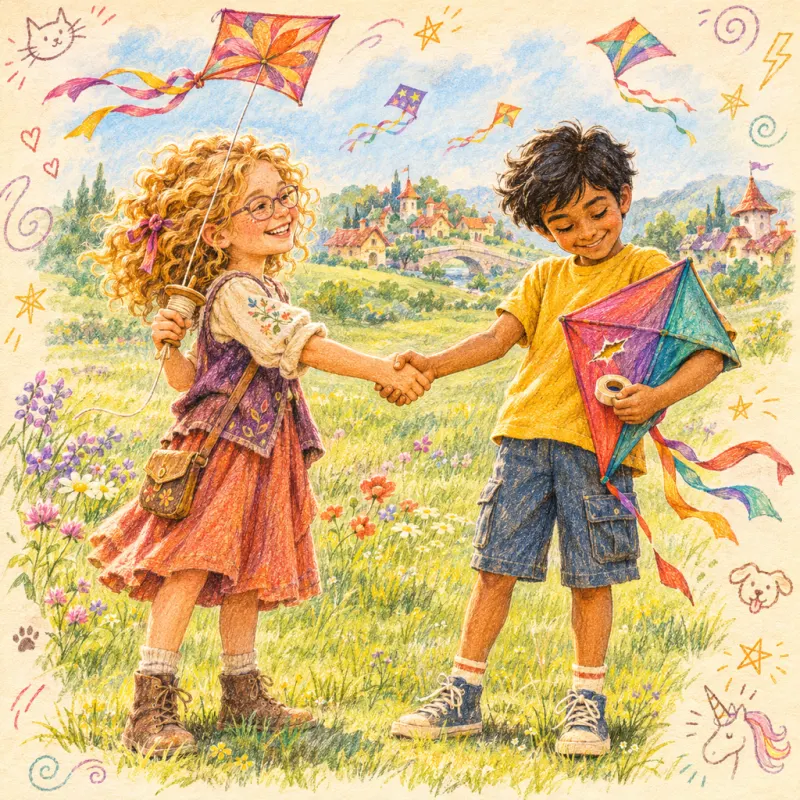
A new character arrives in the world and nobody invites them. The world’s task can only be done with them — the hero notices and calls them over. The last page shows the same step in the playground.
Five steps your child practises
Watch what’s being played
Watch for a while: what the game is, who is doing what, what is missing.
Join in with an offer
Bring something that fits the game: “I’ve got a sail for your raft.”
Ask
“Can I join in?” — out loud, clearly, with a smile.
Cope with “no” and try elsewhere
“No” today doesn’t mean “never”. The hero tries another group or just one person.
Invite one friend
One good friend is enough to start with. And the other way round: notice who is on the sidelines and invite them in.
How the story shows it
The hero is new on the island, on the planet or at knight school. They are never “the poor thing” — they have a strength the others don’t know about yet.
- 1 · Discover
The hero stands on the sidelines, waiting for someone to notice. Nothing happens. Then they see another character join in by offering something to the game.
- 2 · Try
Your child decides what the hero brings and what they say. For the first time, the hero hears “no” — and tries somewhere else.
- 3 · Teach
Another new child arrives on the island. The hero notices them and invites them over — now they know what it feels like.
The last page: break time in the school playground — the same step, one simple sentence.
By age
- Development
- Often plays alongside others and is starting to play together; one simple sentence, “Let’s play”, helps.
- In the story
- Playing side by side, borrowing a toy, one sentence: “Can I play with you?”
- Development
- Belonging to a group matters; in a study with 8–9-year-olds, exclusion hit self-esteem hardest. Abrams et al. 2011
- In the story
- Game rules and joining in with an offer; coping with “no” without tears and trying elsewhere.
- Development
- Standing in the group is key; in teasing and bullying every child has a role — including the one who just watches. Salmivalli et al. 1996
- In the story
- Friendship groups and being left out; finding one friend with a shared interest, recognising when it is bullying.
- Development
- Exclusion hit 13–14-year-olds mainly in their sense of belonging; groups and online spaces play a big part. Abrams et al. 2011
- In the story
- Groups and group chats; their self-worth doesn’t depend on one group of friends.
What we base this on
The approach
Being left out hurts even briefly — it threatens self-esteem and the sense of belonging. Acceptance has to come from the people around the child (adults and the group), not just from “training” the child who is on the sidelines; working towards a shared goal improves relationships more than competition. That’s why the topic has two sides: joining in and inviting someone else.
The rating is about the approach, not about our comic — the comic itself has not yet been scientifically tested.
What the research says
Exclusion threatens belonging, self-esteem, a sense of control and of meaning; long-term exclusion is linked to helplessness and depression.
In a short online ball game in which children were “left out”, exclusion hit 8–9-year-olds mainly in their self-esteem and 13–14-year-olds in their sense of belonging.
When the whole group learned to be accepting (the MOSAIC programme), children with ADHD had a better standing among peers and more friendships, especially boys.
Working together towards a shared goal was linked to better peer relationships and better achievement than competing or working alone.
What we don’t promise on this topic
That the comic will “find your child friends”. Acceptance also depends on the people around them — if a child is repeatedly left out, we recommend talking to the school.
Key sources
- Williams, K. D. (2007). Ostracism. Annual Review of Psychology, 58, 425–452. doi.org/10.1146/annurev.psych.58.110405.085641 abstract
- Abrams, D., Weick, M., Thomas, D., Colbe, H., & Franklin, K. M. (2011). On-line ostracism affects children differently from adolescents and adults. British Journal of Developmental Psychology, 29(1), 110–123. doi.org/10.1348/026151010x494089 abstract
- Mikami, A. Y., et al. (2013). A randomized trial of a classroom intervention to increase peers' social inclusion of children with ADHD. Journal of Consulting and Clinical Psychology, 81(1), 100–112. doi.org/10.1037/a0029654 abstract
- Bierman, K. L., & Furman, W. (1984). The effects of social skills training and peer involvement on the social adjustment of preadolescents. Child Development, 55(1), 151. doi.org/10.2307/1129841 metadata
- Roseth, C. J., Johnson, D. W., & Johnson, R. T. (2008). Promoting early adolescents' achievement and peer relationships: The effects of cooperative, competitive, and individualistic goal structures. Psychological Bulletin, 134(2), 223–246. doi.org/10.1037/0033-2909.134.2.223 abstract
- Salmivalli, C., Lagerspetz, K., Björkqvist, K., Österman, K., & Kaukiainen, A. (1996). Bullying as a group process: Participant roles and their relations to social status within the group. Aggressive Behavior, 22(1), 1–15. doi.org/10.1002/(SICI)1098-2337(1996)22:1<1::AID-AB1>3.0.CO;2-T metadata
- abstract abstract or full text read
- metadata bibliographic details verified
- institution official institutional document
Who prepared this and when
Written by the Ink & Brave editorial team from our evidence base (sources verified 8 November 2026, last updated 9 November 2026).
If you feel like it
- If your child likes a classmate, you can invite them round — a book you’ve read is a good reason to get together.
- Don’t keep asking whether they have “made friends yet”. Just be there when they want to talk.
When a comic isn’t enough
- Your child has been on the sidelines for a long time, doesn’t want to go to school, is sad or afraid.
- Someone repeatedly hurts them, mocks them or deliberately leaves them out — that is bullying, and adults must act (see the topic Telling a trusted adult).
- Talk to the class teacher, the school psychologist or counsellor, or a child psychologist.
Need help right now? If someone is in danger, call your local emergency number — 112 in the EU, 999 in the UK, 911 in the US and Canada, 000 in Australia. Child and parent helplines by country
Frequently asked questions
Can the comic help a child who is left out in class?
The comic gives your child a dignified role and lets them practise what to say to join in and how to cope with rejection. But it can’t solve exclusion on its own — if it continues, or if it is bullying, the school and adults must act.
Can a real friend be in the story?
Yes. Parents invite parents and every child has an important role. A comic can be a reason to meet up — but it won’t make friends for anyone, and with bullying it doesn’t replace the school and adults.
Won’t my child become the others’ ‘project’?
No. Nobody finds out why they were invited, and nobody gets kicked out. The group only deals with shared themes, never one child’s personal problems.
Reading for parents
- Article in preparation What can you do when nobody plays with your child?
- Article in preparation How do children learn empathy?
Personalised book: Friends
A personalised book on this topic — a story for €9.90 (1 story · 16 pages) or a whole adventure for €24.90 (3 stories · 48 pages), as a storybook or a comic. A free drawing of the hero first.