What your child practises
After losing, saying how I feel and trying a different strategy — “I can’t do this yet, I’ll try another way.”
The hero loses and wants to give up; they see that the winner used to lose too, and try a different way. The second attempt is better, not necessarily a win — winning is not a reward for good behaviour.
Five steps your child practises
Name the feeling
“I’m disappointed.” Feelings are allowed.
Good game
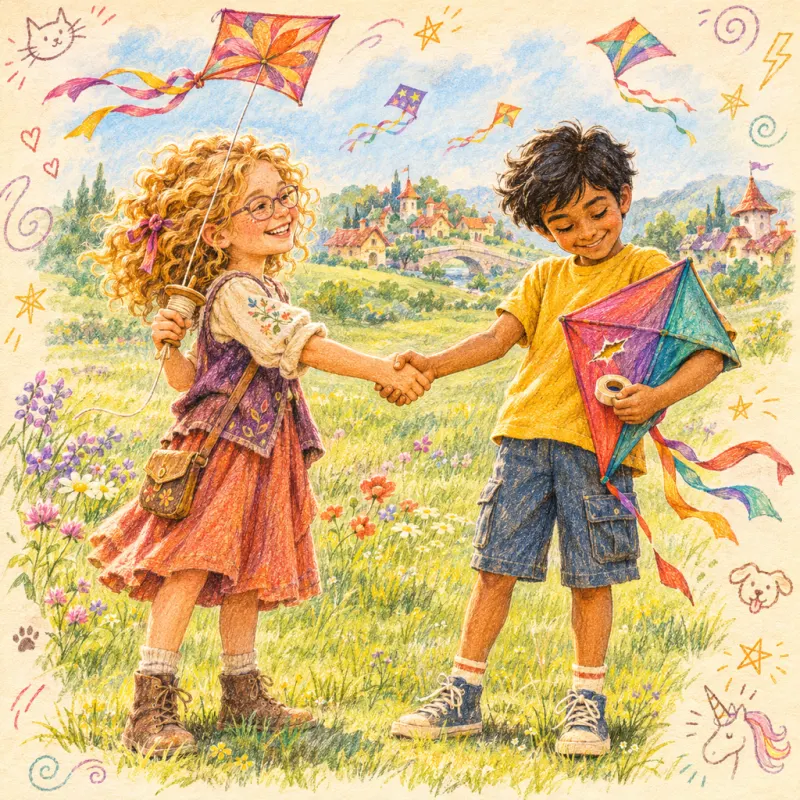
Shake hands or say “well done” — even when it stings.
I can’t do it yet
Not “I can’t do it”, but “I can’t do it yet”.
What will I try differently?
One concrete change: a different strategy, more practice, getting help.
Another go
Better, not necessarily a win.
How the story shows it
A tournament, a race, a spell that won’t work. The hero discovers that even the winner used to lose.
- 1 · Discover
The hero loses the kite race and wants to give up. The winner shows them her very first torn kite.
- 2 · Try
Your child decides what the hero will change — and the hero tries it on the second go.
- 3 · Teach
A younger friend cries after losing; the hero gives them advice in their own words.
The last page: losing a board game at home — “good game” and one more round.
By age
- Development
- Taking turns and waiting are still being learned; more cooperation than competition helps. Diamond & Lee 2011
- In the story
- Short games, one sentence — “let’s try again next time” — and lots of working together instead of competing.
- Development
- Starts comparing themselves with others (who is faster, who reads better) — and is vulnerable to labels. Harter 2012
- In the story
- Rules and fair play; losing in games and at school.
- Development
- Comparison is strong; the experiments on praising effort versus intelligence were done with exactly this age (fifth-graders). Mueller & Dweck 1998
- In the story
- Comparing themselves with others; practice and strategy instead of “talent”.
- Development
- Sensitive to being judged by others — a mistake in front of classmates hurts; we never humiliate the hero in public. Somerville 2013
- In the story
- Mistakes in front of others, embarrassment; humour and their own plan.
What we base this on
The approach
Praise the process and the strategy (“you tried a different way”) rather than talent, and treat mistakes as a normal part of learning. We use the “not yet” idea only lightly — research does not clearly confirm that mindset programmes improve school results, so we don’t promise that.
The rating is about the approach, not about our comic — the comic itself has not yet been scientifically tested.
What the research says
Children praised for intelligence (“you must be clever”) persisted less and performed worse after a failure than children praised for effort.
Children who heard more process praise at ages 1–3 were more likely at 7–8 to believe that abilities can be developed through effort.
Growth-mindset programmes had an average effect on school results of d = 0.05, not significant after correcting for publication bias; another team points to large differences between groups of children.
What we don’t promise on this topic
Better grades or a “growth mindset”. What we promise is a story in which the hero wins through strategy, not talent.
Key sources
- Mueller, C. M., & Dweck, C. S. (1998). Praise for intelligence can undermine children's motivation and performance. JPSP, 75(1), 33–52. doi.org/10.1037/0022-3514.75.1.33 abstract
- Gunderson, E. A., Gripshover, S. J., Romero, C., Dweck, C. S., Goldin-Meadow, S., & Levine, S. C. (2013). Parent praise to 1- to 3-year-olds predicts children's motivational frameworks 5 years later. Child Development, 84(5), 1526–1541. doi.org/10.1111/cdev.12064 abstract
- Sisk, V. F., Burgoyne, A. P., Sun, J., Butler, J. L., & Macnamara, B. N. (2018). To what extent and under which circumstances are growth mind-sets important to academic achievement? Two meta-analyses. Psychological Science, 29(4), 549–571. doi.org/10.1177/0956797617739704 abstract
- Macnamara, B. N., & Burgoyne, A. P. (2023). Do growth mindset interventions impact students' academic achievement? Psychological Bulletin, 149(3–4), 133–173. doi.org/10.1037/bul0000352 abstract
- Burnette, J. L., et al. (2023). A systematic review and meta-analysis of growth mindset interventions: For whom, how, and why might such interventions work? Psychological Bulletin, 149(3–4), 174–205. doi.org/10.1037/bul0000368 abstract
- Harter, S. (2012). The construction of the self: Developmental and sociocultural foundations (2nd ed.). metadata
- Diamond, A., & Lee, K. (2011). Interventions shown to aid executive function development in children 4 to 12 years old. Science, 333(6045), 959–964. doi.org/10.1126/science.1204529 metadata
- Somerville, L. H. (2013). The teenage brain: Sensitivity to social evaluation. Current Directions in Psychological Science, 22(2), 121–127. doi.org/10.1177/0963721413476512 metadata
- abstract abstract or full text read
- metadata bibliographic details verified
- institution official institutional document
Who prepared this and when
Written by the Ink & Brave editorial team from our evidence base (sources verified 8 November 2026, last updated 9 November 2026).
If you feel like it
- When something doesn’t work out for your child, praise the attempt: “You tried a different way.”
- Every now and then, play a game where you lose — and show them what a “good game” looks like.
When a comic isn’t enough
- Losing leads to very intense outbursts, or your child stops trying anything new.
- Talk to a paediatrician or GP, the school psychologist or counsellor, or a child psychologist.
Need help right now? If someone is in danger, call your local emergency number — 112 in the EU, 999 in the UK, 911 in the US and Canada, 000 in Australia. Child and parent helplines by country
Frequently asked questions
My child can’t handle losing. Is that normal?
For many children, yes. The comic helps them practise what to do after losing; we don’t promise a result or a timescale.
Does the hero have to win at the end?
No. At the end there is a better attempt, not necessarily a win.
Is it suitable for mistakes at school, too?
Yes. The same steps apply to a mistake in a spelling test and to losing a football match.
Reading for parents
- Article in preparation How can you support a child’s learning without pressure?
- Article in preparation How can you help a child who can’t stand losing?
Personalised book: Losing and mistakes
A personalised book on this topic — a story for €9.90 (1 story · 16 pages) or a whole adventure for €24.90 (3 stories · 48 pages), as a storybook or a comic. A free drawing of the hero first.