Has it just happened?
- Tell them honestly and simply, using the words “died” or “dead”. Avoid “went to sleep” or “passed away” — younger children may take them literally.
- If faith matters to your family, share it — and add the simple fact that the body has stopped working and no longer hurts.
- Ask your child what they think and what they are afraid of; answer patiently, even when the questions repeat.
- Invite them to the farewell or funeral if they want to go — tell them beforehand what they will see. Don’t force them.
- Tell them it is not their fault, and keep everyday life as normal as you can.
Where to find grief support
- Child Bereavement UK (United Kingdom) ↗ — helpline 0800 02 888 40, Mon–Fri 8am–8pm
- Dougy Center — program finder (US and worldwide) ↗ — grief support groups for children and families
- Plamienok — Pomoc v smútení (Slovakia) ↗ — grief support for children after a loss and consultations for parents (in Slovak)

What your child practises
Name sadness and other feelings, ask questions, remember, and know the loss is not my fault — with an adult nearby.
The story gives your child words and shows that sadness is allowed. But the real support comes from a close adult, not a comic.
What your child tries out in the story
Name what I feel
Sadness, anger, fear and even a moment of laughter — all of it is allowed. The hero says how they feel and the adult accepts it.
Ask questions
Questions may come again and again. The hero asks and gets an honest, simple answer.
Remember
The hero finds their own way to remember — a drawing, an object, a place, a story.
It’s not my fault
Children sometimes think their thoughts or words caused the loss. The story calmly says that isn’t so.
How a story could show it
A working draft: the loss happens to an invented character in the world, not to your child; we never draw death, illness or a funeral in detail. Comforts such as “she’s in heaven” are used only if the family chooses them.
- 1 · Discover
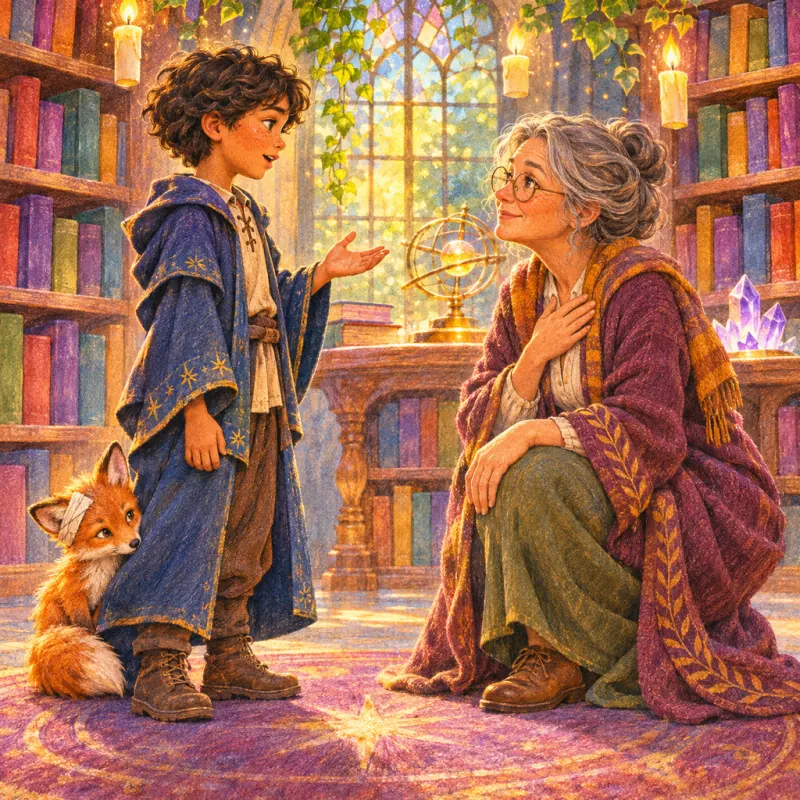
A friend in the world is sad because their pet or grandma has died. The hero doesn’t know what to say — and finds that being there is enough.
- 2 · Try
The hero helps the friend name their feelings and ask an adult what happened. The adult answers honestly and simply.
- 3 · Teach
Together they create a way to remember — a little light, a tree, a drawing. The sadness doesn’t vanish, but nobody has to carry it alone.
Last page: an ordinary evening at home — “Mum, Tom’s dog died. What should I say to him?” — “That you’re there for him. And that it’s OK to be sad.”
By age
- Development
- Young children take words literally; short, honest sentences help. Schonfeld et al. 2016
- In the story
- Short, honest sentences, the same answer even the hundredth time. “Died” rather than “went to sleep” — otherwise a child may become afraid of sleeping.
- Development
- Understanding of death develops gradually; questions repeat. Speece & Brent 1984; Schonfeld et al. 2016
- In the story
- Lots of “why” and “what happens” questions. The story lets the questions be asked and answers them calmly.
- Development
- Older children may decide for themselves whether to take part in a farewell. Schonfeld et al. 2016
- In the story
- Understands more, but needs just as much space and an adult nearby. Invite them to the farewell and let them decide — just as with younger children who have been prepared.
What we base this on
The approach
Speak honestly and simply (“died”, not “went to sleep”), answer repeated questions patiently, ask what the child is thinking, share religious explanations only as the family wishes and together with facts, invite the child to a farewell if they want, never force them.
The rating is about the approach, not about our comic — the comic itself has not yet been scientifically tested.
What the research says
With age, children gradually understand that death is permanent, that the body stops working, that it happens to everyone, and what causes it.
Paediatricians advise avoiding euphemisms and saying “died”; a child told a loved one is “sleeping” may become afraid of going to sleep.
Until a child understands why a death happened, they may think their thoughts or actions caused it and feel guilty.
What we don’t promise on this topic
That the comic will ease grief or replace a close adult or professional help. Our comic’s effect is untested; the topic is still in preparation.
Key sources
- Speece, M. W., & Brent, S. B. (1984). Children's understanding of death: A review of three components of a death concept. Child Development, 55(5), 1671. doi.org/10.2307/1129915 metadata
- Schonfeld, D. J., Demaria, T., & AAP (2016). Supporting the grieving child and family. Pediatrics, 138(3), e20162147. doi.org/10.1542/peds.2016-2147 metadata
- abstract abstract or full text read
- metadata bibliographic details verified
- institution official institutional document
Who prepared this and when
Written by the Ink & Brave editorial team from our evidence base (sources verified 8 November 2026, last updated 9 November 2026).
If you feel like it
- Remember something good together: a photo, a recipe, a song.
- Say that you feel sad too — your child learns that sadness is allowed.
When a comic isn’t enough
- Grief stays intense for a long time and changes sleep, eating, school or play, or your child withdraws or keeps blaming themselves — talk to your GP, paediatrician or a child psychologist. If you’re worried, you can ask for help at any time, sooner too.
- If your child says they don’t want to live, or want to be with the person who died, take it seriously even in young children and seek help today.
- Grief support for children and families: in the UK, Child Bereavement UK (0800 02 888 40, Mon–Fri 8am–8pm); in the US, the Dougy Center’s program finder (dougy.org).
Choose your country and we’ll show the right numbers. If someone is in danger, call the emergency number now: 112 in the EU, 999 in the UK, 911 in the US and Canada, 000 in Australia.
Another country
We pick help by the country you are in, not by the website’s language. Conditions, call costs and opening hours are listed by each service. Checked 9 November 2026. Somewhere else? Child Helpline International (child helplines by country). Helplines in every country
Frequently asked questions
Isn’t this too sad for a child?
The story will be calm and hopeful: the loss happens to an invented character, with no details of death, and an adult is always close by. The topic is still in preparation and not for sale.
Can it be about our own loss?
We are still considering that while preparing the story. Today we plan a story in which an invented character experiences the loss and the hero — your child — helps them; your child can add their own memories if they want.
Does this apply when a pet dies?
Yes. A pet’s death is often the first loss a child experiences; honest words and remembering together help then too.
Personalised book: Grief and loss (coming soon)
The ‘Grief and Loss’ story is in preparation and not for sale yet. If you’d like to know when it’s ready, email us — we’ll use your email for that one message only.