What your child practises
Noticing anger in the body, stopping, calming down (for example with a “dragon breath”) and saying in words what I want — without hurting anyone.
The hero has a power that explodes when they get angry. On the second-to-last page they see that a friend got scared; on the last page they use the breath and say what is making them angry. The technique comes up twice in the story, and at the end the hero puts it in plain words.
Five steps your child practises
Notice the signs in the body
Hot cheeks, clenched fists, a pounding heart — “the volcano is waking up”.
Stop and step back
Stop, take a step back, hands to yourself. Don’t hurt anyone.
Calm down
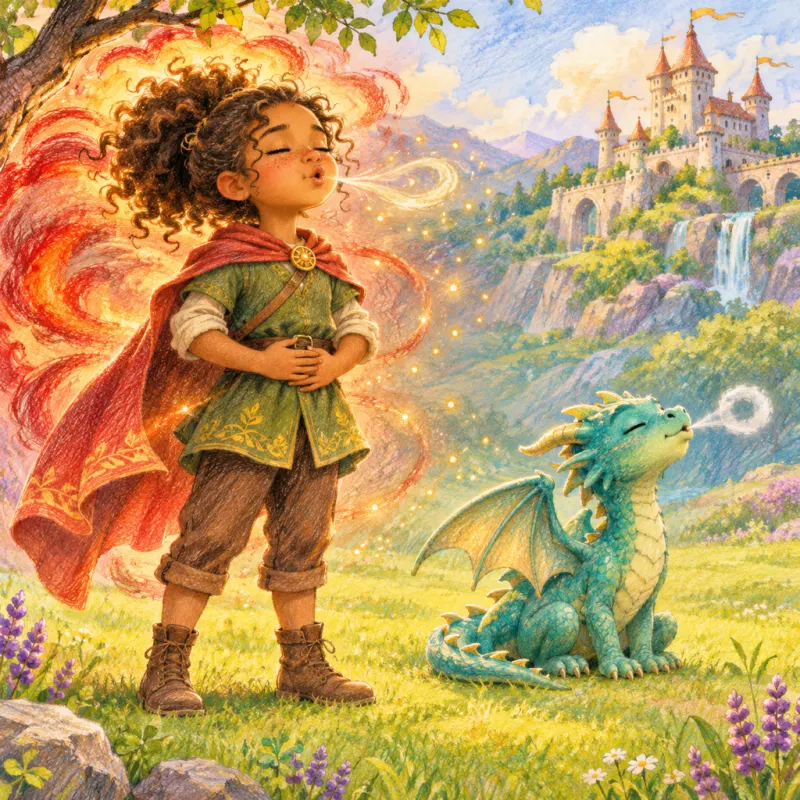
A slow “dragon breath”, like blowing out birthday candles, counting to five, or a calm place.
Say in words what I want
“I’m cross that you knocked my tower down. I want to build it again.”
Put right what went wrong
If something got broken or someone got hurt — say sorry and help.
How the story shows it
The hero has a power that bursts out when they get angry — fire, a storm, a magnet. Your child chooses the world; the skill is always the same.
- 1 · Discover
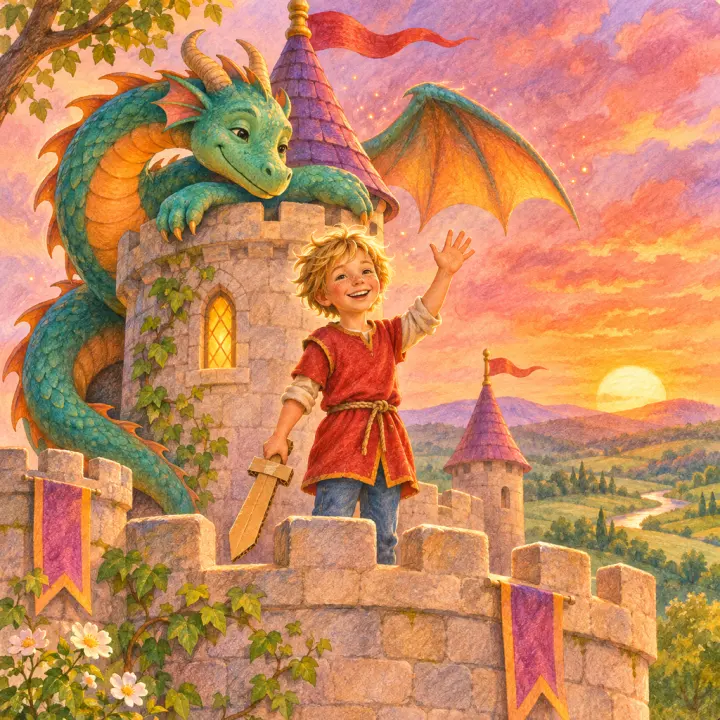
The hero’s volcano erupts and spoils something lovely. An old dragon shows them how to blow until the fire calms down.
- 2 · Try
Your child makes up what the hero says instead of exploding. In a tougher moment, the hero tries it — and it at least half works.
- 3 · Teach
A little dragon is angry. The hero gives advice in their own words; your child receives the Hero Card “When I’m boiling inside, …”.
The last page of the book: the same step at home — when a sister knocks over the block tower.
By age
- Development
- Can tell basic feelings apart (happy, sad, angry, scared); holding back and waiting are still being learned. One step and one word for the feeling help. Pons et al. 2004; Diamond & Lee 2011
- In the story
- A short story without tension; anger as a little animal or the weather, one step (breathing). A parent reads the comic aloud.
- Development
- Gradually understands mixed feelings and that feelings can be hidden; can notice what made them angry. Pons et al. 2004; Harter & Buddin 1987
- In the story
- The full five-step routine; the hero names the feeling and says the line your child made up.
- Development
- Sensitive to “you must” and to control — a controlling tone worsened deeper learning in 11–12-year-olds. Knowing one’s own triggers helps. Vansteenkiste et al. 2005
- In the story
- Anger among friends and in games; the focus is on words and making amends, less on “magic”.
- Development
- Rules delivered in a controlling way were associated with more defiance in adolescents; so we offer their own plan and respect, not a lecture. Van Petegem et al. 2015
- In the story
- No lecturing, more humour and more of their own choices; a style such as manga or graffiti, for example.
What we base this on
The approach
Emotion coaching: feelings are allowed, hurting is not. The adult names the feeling and accepts it, and only then do you look for a solution together. Children’s self-control improves with practice that gradually gets harder — which is why the technique repeats within the story.
The rating is about the approach, not about our comic — the comic itself has not yet been scientifically tested.
What the research says
Emotion coaching — noticing a feeling, naming it, accepting it and looking for a solution — was described by John Gottman’s team.
After the Tuning in to Kids parenting programme, parents coached their children’s emotions more and dismissed them less.
In a further study of the same programme, children had fewer behaviour problems after their parents took the course, as rated by teachers.
Stopping and holding back (executive functions) improves in children with practice that gets gradually harder.
The popular idea that “willpower runs out” was not confirmed by a large replication (d = 0.04) — so we don’t use it in our stories.
What we don’t promise on this topic
That the comic will stop angry outbursts. The evidence is for parenting programmes; the comic itself has not yet been tested.
Key sources
- Gottman, J. M., Katz, L. F., & Hooven, C. (1996). Parental meta-emotion philosophy and the emotional life of families. Journal of Family Psychology, 10(3), 243–268. doi.org/10.1037/0893-3200.10.3.243 metadata
- Havighurst, S. S., Wilson, K. R., Harley, A. E., Prior, M. R., & Kehoe, C. (2010). Tuning in to Kids: Improving emotion socialization practices in parents of preschool children. Journal of Child Psychology and Psychiatry, 51(12), 1342–1350. doi.org/10.1111/j.1469-7610.2010.02303.x abstract
- Havighurst, S. S., et al. (2013). "Tuning into Kids": Reducing young children's behavior problems using an emotion coaching parenting program. Child Psychiatry & Human Development, 44(2), 247–264. doi.org/10.1007/s10578-012-0322-1 abstract
- Eisenberg, N., Spinrad, T. L., & Eggum, N. D. (2010). Emotion-related self-regulation and its relation to children's maladjustment. Annual Review of Clinical Psychology, 6, 495–525. doi.org/10.1146/annurev.clinpsy.121208.131208 metadata
- Diamond, A., & Lee, K. (2011). Interventions shown to aid executive function development in children 4 to 12 years old. Science, 333(6045), 959–964. doi.org/10.1126/science.1204529 metadata
- Hagger, M. S., et al. (2016). A multilab preregistered replication of the ego-depletion effect. Perspectives on Psychological Science, 11(4), 546–573. doi.org/10.1177/1745691616652873 abstract
- Pons, F., Harris, P. L., & de Rosnay, M. (2004). Emotion comprehension between 3 and 11 years: Developmental periods and hierarchical organization. European Journal of Developmental Psychology, 1(2), 127–152. doi.org/10.1080/17405620344000022 metadata
- Harter, S., & Buddin, B. J. (1987). Children's understanding of the simultaneity of two emotions: A five-stage developmental acquisition sequence. Developmental Psychology, 23(3), 388–399. doi.org/10.1037/0012-1649.23.3.388 metadata
- Vansteenkiste, M., Simons, J., Lens, W., Soenens, B., & Matos, L. (2005). Examining the motivational impact of intrinsic versus extrinsic goal framing and autonomy-supportive versus internally controlling communication style. Child Development, 76(2), 483–501. doi.org/10.1111/j.1467-8624.2005.00858.x abstract
- Van Petegem, S., Soenens, B., Vansteenkiste, M., & Beyers, W. (2015). Rebels with a cause? Adolescent defiance from the perspective of reactance theory and self-determination theory. Child Development, 86(3), 903–918. doi.org/10.1111/cdev.12355 abstract
- abstract abstract or full text read
- metadata bibliographic details verified
- institution official institutional document
Who prepared this and when
Written by the Ink & Brave editorial team from our evidence base (sources verified 8 November 2026, last updated 9 November 2026).
If you feel like it
- When things are calm, you can play “dragon breath” together — who can blow more slowly?
- You can put the Hero Card on the fridge. If your child doesn’t want to, that’s fine.
When a comic isn’t enough
- Outbursts are very frequent or long, or your child hurts themselves or others during them.
- The anger goes hand in hand with sadness, fear or problems at school.
- In that case, talk to a paediatrician or GP, the school psychologist or counsellor, or a child psychologist.
Need help right now? If someone is in danger, call your local emergency number — 112 in the EU, 999 in the UK, 911 in the US and Canada, 000 in Australia. Child and parent helplines by country
Frequently asked questions
Is anger normal in children?
Yes. Anger is an ordinary feeling. The comic doesn’t show your child that they mustn’t get angry — it shows how to calm down and say what they want without hurting anyone.
What is dragon breath?
A slow breath out, as if your child were blowing out the candles on a cake. In the story, the hero sees a dragon do it and then tries it themselves.
Do I have to ‘teach’ my child when they are angry?
No. The story shows the steps. During an outburst, it’s enough to stay calmly close by; you can talk about the story later when things are calm — if you want to.
Reading for parents
Personalised book: Anger and calming down
A personalised book on this topic — a story for €9.90 (1 story · 16 pages) or a whole adventure for €24.90 (3 stories · 48 pages), as a storybook or a comic. A free drawing of the hero first.