Who it’s for
For children who have a disabled friend in their class, family or playground — and for those who haven’t met one yet. You add the friend with one tick in the order; they’re made up and we don’t ask for information about a real friend. If your child wears hearing aids, glasses or another aid from the character builder, pick it for the hero — the hero will have it the way your child uses it, and the story will be about what your child invents.
What your child practises
Being with a disabled friend just as with anyone: asking instead of guessing, not helping without asking, talking to them directly, waiting, adapting the game so everyone can play.
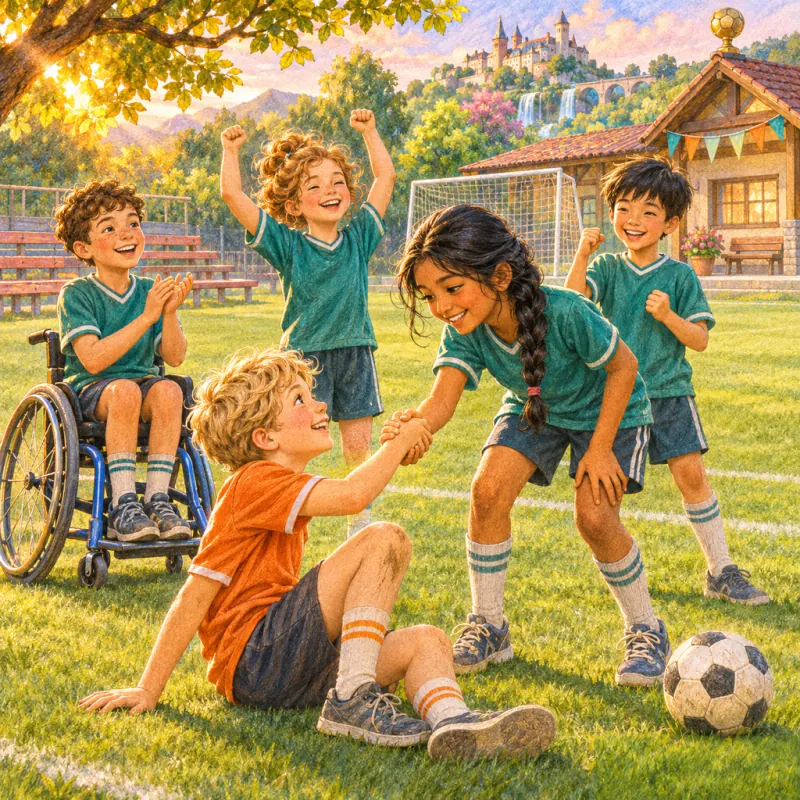
The hero and the friend want the same thing — treasure, a win, a fixed rocket — and neither can do it without the other. Both bring their own ideas, and the friend has their own mistake too. When they misunderstand each other, they work it out — the friend says what they need, themselves, in their own way. The aid is mentioned rarely and in plain words. Nobody pities anyone and nothing gets cured.
Ordinary things the story shows in action (one or two per book)
Asking
Asking instead of guessing: “Do you want a hand?” — and respecting a “no”.
Not helping without asking
Not taking things out of the friend’s hands or doing things for them unless they want it.
Talking to them directly
Talking with the friend, not with their mum or helper over their head.
Waiting
Giving time and not finishing the friend’s sentences.
Adapting the game
Changing the rules or the place so that everyone can play.
What it looks like in the book
Two made-up examples. The aid is part of the character, not the topic — the plot is about the adventure, and understanding grows from a shared goal.
- A hero with an aid
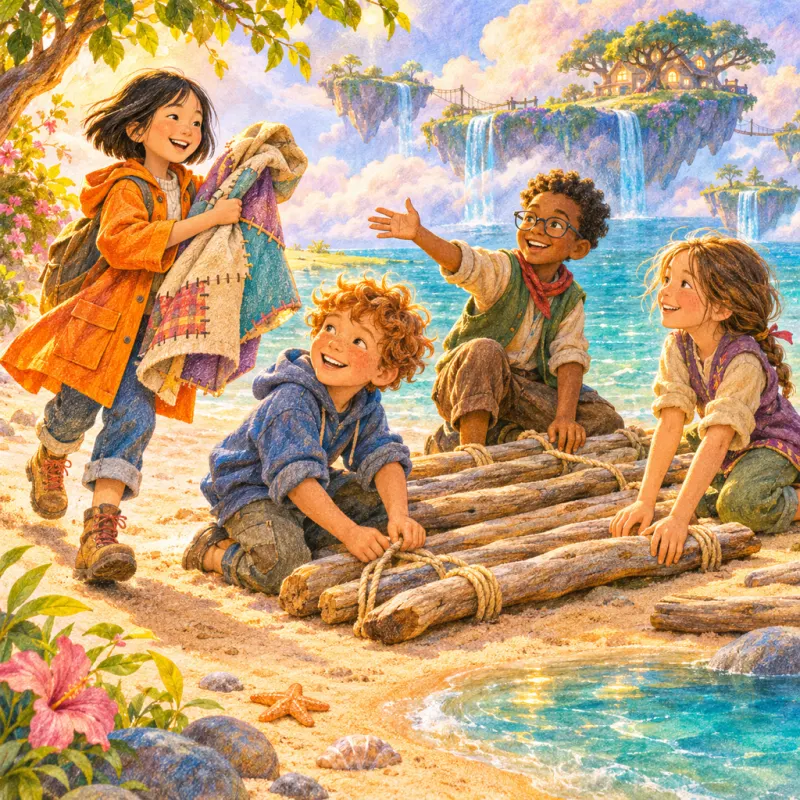
Ema (8) captains a raft on Pirate Island and reads sea currents better than anyone. She uses a wheelchair with a turquoise frame — the harbour and the raft are simply ready for it, without a word. The book is about a raft race with her cousin for a piece of the Great Map, and about losing by two seconds. The wheelchair isn’t mentioned once. You can read the opening in the Samples (ages 7–9) — also in a second version where Ema is the hero’s friend.
- A friend with an aid
Kubo (8) and Lea (8) are fixing the radio on a space station before the supply ship arrives. Lea wears a hearing aid in her left ear, cracks more jokes than Buzz the robot and keeps pressing buttons she shouldn’t. Once Kubo talks to her with his back turned; Lea: “Helloo, my brain doesn’t read the back of your head.” From then on he turns to face her. They only fix the radio when they combine Kubo’s plan with Lea’s button-pressing habit.
The last page, if there is one: an ordinary afternoon — Kubo and Lea having ice cream and arguing about which flavour is best. Nothing is explained.
By age
- Development
- Notices differences out loud and asks directly; that isn’t rudeness.
- In the story
- The aid is in the picture, friend and hero play together, one ordinary thing (waiting, handing something over).
- Development
- Wants to know “why” and “how”; in one study, imagining play with a child with a physical disability improved attitudes, and willingness to be friends rose only among 5–6-year-olds. Cameron et al. 2011
- In the story
- One curious question and the friend’s short answer in their own words.
- Development
- Sensitive to what the group thinks; in a survey, more contact was linked to more positive attitudes and less uncertainty, more strongly in primary school. Armstrong et al. 2016
- In the story
- Nothing is explained; any misunderstanding is sorted out in action.
- Development
- Wants realistic, normal portrayals rather than exceptional ones (interviews with neurodivergent 14–17-year-olds). Webber et al. 2024
- In the story
- The friend has a life of their own; the hero never speaks for them.
What we base this on
The approach
Children’s attitudes towards disabled peers improved when they experienced or read about friendship — direct contact, and “extended” contact where the friend is someone like them. For contact through media alone, a meta-analysis did not reliably confirm an effect (and extended contact was tested in only two studies). Acceptance comes from the whole group, not a “lesson” for one child, and stories with stereotypes (pity, the “brave little soul”, a miracle cure) can make attitudes worse. That’s why we decided that the friend in the story has their own goal, the difference stays visible and the moral is never spelled out — an editorial choice, not a proven effect.
The rating is about the approach, not about our comic — the comic itself has not yet been scientifically tested.
What the research says
Children who spent 6 weeks reading stories about friendships between disabled and non-disabled children then had more positive attitudes towards disabled people.
Across 12 school studies, both direct contact (d = 0.55) and extended contact through friendship (d = 0.61) improved children’s attitudes; for contact through media alone, an effect was not reliably confirmed.
When pre-schoolers watched an episode meant to promote acceptance of a disabled character, most missed the moral. In the version where others first feared the character, children who better understood the characters’ feelings got the message less; in the version without fear, more.
Programmes that improved attitudes towards disabled peers usually had several components and several sessions.
Children’s books long portrayed disability through pity and exclusion; newer books more often show characters who make their own choices, with disability as just one of their traits.
In a study, image-generating AI repeatedly showed simplified stereotypes of disability — which is why we describe every aid precisely and a person checks it.
What we don’t promise on this topic
That the book will teach your child to accept a classmate or change their behaviour. Studies measured attitudes shortly after reading, and several sessions plus real contact worked better. A book can start a conversation. It isn’t therapy.
Key sources
- Cameron, L., & Rutland, A. (2006). Extended contact through story reading in school: Reducing children's prejudice toward the disabled. Journal of Social Issues, 62(3), 469–488. doi.org/10.1111/j.1540-4560.2006.00469.x abstract
- Armstrong, M., Morris, C., Abraham, C., & Tarrant, M. (2017). Interventions utilising contact with people with disabilities to improve children's attitudes towards disability: A systematic review and meta-analysis. Disability and Health Journal, 10(1), 11–22. doi.org/10.1016/j.dhjo.2016.10.003 abstract
- Armstrong, M., Morris, C., Abraham, C., Ukoumunne, O. C., & Tarrant, M. (2016). Children's contact with people with disabilities and their attitudes towards disability: A cross-sectional study. Disability and Rehabilitation, 38(9), 879–888. doi.org/10.3109/09638288.2015.1074727 abstract
- Cameron, L., Rutland, A., Turner, R. N., Holman-Nicolas, R., & Powell, C. (2011). „Changing attitudes with a little imagination“: Imagined contact effects on young children's intergroup bias. Anales de Psicología, 27(3), 708–717. abstract
- Mares, M.-L., & Acosta, E. E. (2008). Be kind to three-legged dogs: Children's literal interpretations of TV's moral lessons. Media Psychology, 11(3), 377–399. doi.org/10.1080/15213260802204355 abstract
- Lindsay, S., & Edwards, A. (2013). A systematic review of disability awareness interventions for children and youth. Disability and Rehabilitation, 35(8), 623–646. doi.org/10.3109/09638288.2012.702850 abstract
- Kleekamp, M. C., & Zapata, A. (2019). Interrogating depictions of disability in children's picturebooks. The Reading Teacher, 72(5), 589–597. doi.org/10.1002/trtr.1766 abstract
- Dyches, T. T., & Prater, M. A. (2005). Characterization of developmental disability in children's fiction. Education and Training in Developmental Disabilities, 40(3), 202–216. doi.org/10.1177/215416470504000303 abstract
- Mack, K., Qadri, R., Denton, E., Kane, S. K., & Bennett, C. L. (2024). „They only care to show us the wheelchair“: Disability representation in text-to-image AI models. CHI '24, 1–23. doi.org/10.1145/3613904.3642166 abstract
- Webber, C., Santi, E., Cebula, K., Crompton, C. J., & McGeown, S. (2024). Representation of neurodivergence in fiction books: Exploring neurodivergent young peoples' perspectives. Literacy, 58(3), 322–334. doi.org/10.1111/lit.12369 abstract
- Dohovor OSN o právach osôb so zdravotným postihnutím, čl. 8 (oznámenie MZV SR č. 317/2010 Z. z.) static.slov-lex.sk/static/SK/ZZ/2010/317/20100710.html institution
- abstract abstract or full text read
- metadata bibliographic details verified
- institution official institutional document
Who prepared this and when
Written by the Ink & Brave editorial team from our evidence base (sources verified 8 November 2026, last updated 9 November 2026).
Questions for talking after reading
A bonus, not homework — and not “what did you learn”.
Ages 4–8
- What was the funniest thing about Lea?
- What did Lea want, herself?
- Why did Kubo start turning to face her?
- What would you like to play with her?
Ages 9–14
- When did Kubo think he was helping, but wasn’t?
- How would you ask?
- Do you know someone with an aid or a disability? What would make them comfortable — and how would you find out?
- Why does the book hardly mention the hearing aid?
If you feel like it
- When your child asks about someone with an aid, answer briefly and truthfully. That person can join in if they want to — they don’t have to explain their body or their aid to anyone.
- Don’t quiz your child about whether they’re “friends yet”. Just be there when they want to talk.
When a comic isn’t enough
- If a disabled child in the class is teased or left out, that’s a job for adults — talk to the school (class teacher, school psychologist) and treat hurting as bullying (topic: Telling a trusted adult).
- If your child is troubled for a long time by their own diagnosis or aid, a child psychologist, doctor or parents’ organisation can help.
Need help right now? If someone is in danger, call your local emergency number — 112 in the EU, 999 in the UK, 911 in the US and Canada, 000 in Australia. Child and parent helplines by country
Frequently asked questions
Can there be a disabled friend in the story?
Yes. It’s a made-up character you add with one tick in the order — for example, a friend with hearing aids. They have their own goal and mistakes, and a shared adventure brings them and the hero together. We don’t ask for information about a real friend. We can’t add a real classmate to the story yet.
Can the hero have an aid, such as hearing aids or glasses?
Yes. Pick it from the pictures in the character builder: glasses, hearing aids, ear defenders, an arm sensor, an eye patch or a wheelchair. We only offer what we can draw reliably — so for now the wheelchair only in the Clear Line, Storybook, Clay, Manga and Video Game styles; more aids are in preparation. We keep the chosen aid in the adventure world too — the world may adapt it, never remove it. We don’t need a diagnosis.
Will the book help my child accept disabled children?
We don’t promise that. In studies, stories about friendship improved children’s attitudes, but attitudes were measured shortly after reading, not behaviour, and several sessions plus real contact worked better. A book can start a conversation — you’ll find questions above.
Reading for parents
- Article in preparation Why does it matter that disabled children see themselves in books?
A personalised book with a disabled friend
A personalised book on this topic — a story for €9.90 (1 story · 16 pages) or a whole adventure for €24.90 (3 stories · 48 pages), as a storybook or a comic. A free drawing of the hero first.