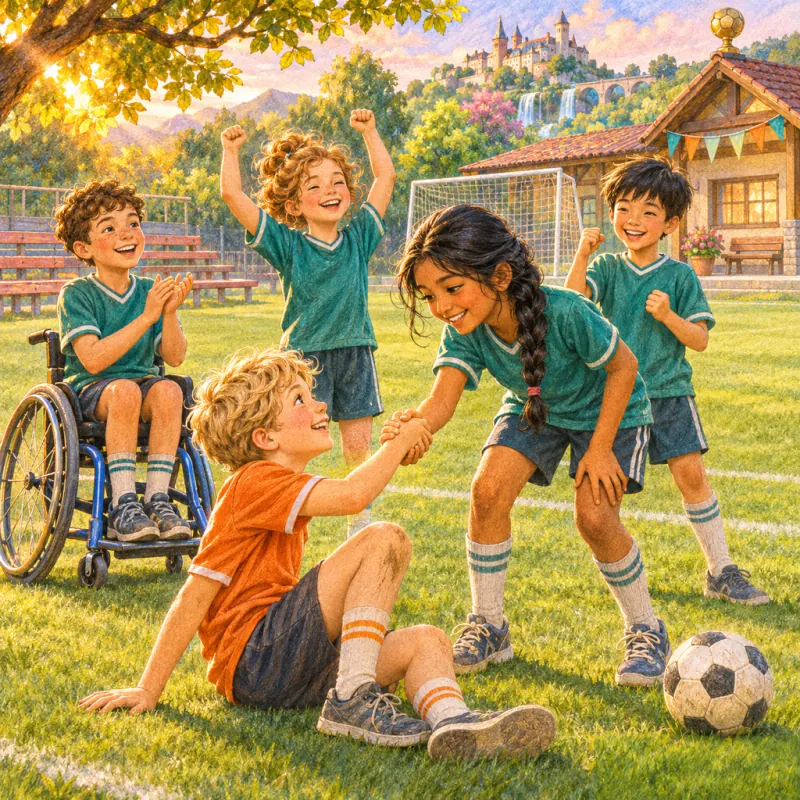

A girl with hearing aids, a boy who uses a wheelchair or a classmate who needs more time joins the class. Children notice — and often ask out loud, in a shop, at the playground, right in front of that child. The parent goes pale. There’s no need.
Is it OK that my child asks out loud?
Yes. A curious question isn’t rudeness; it’s how a child makes sense of the world. It’s worse when they learn that “we don’t talk about that” — then they learn that there is something wrong with being different. Answer calmly, in ordinary words: “That’s a wheelchair. Ema rides in it, just like you walk.” If the classmate is nearby and wants to join in, talk with them, not about them — guidance on communicating with disabled people recommends speaking to them directly, not about them over their heads (Supreme Administrative Court of the Slovak Republic).
Does it help to explain to my child what the disability is?
A little, but less than we might expect. In a survey of 1,881 children aged 7–16, more positive attitudes were linked mainly to contact — and about a third of that link was explained by children feeling less uncertain about how to behave, and by more empathy (Armstrong et al., 2016; this was an association, not an experiment). A review of 42 programmes found that the ones that worked better had several components and several sessions — knowledge, contact and conversation (Lindsay & Edwards, 2013).
What this means for parents: there’s no need for a lecture about a diagnosis. A few concrete things that reduce your child’s uncertainty help more:
- Ask: “Would you like a hand?” — and respect a “no”.
- Don’t help without asking (don’t push the wheelchair, don’t take things out of their hands).
- Talk to them directly, not to their mum or their teaching assistant.
- Wait, and don’t finish their sentences.
- Adapt the game so you can play it together.
- Don’t stroke a working dog without asking.
The same advice appears in guidance on communicating with disabled people (Supreme Administrative Court of the Slovak Republic).
Do books about disabled children help?
They can, if they are well written. In a British study, children aged 5–10 spent 6 weeks reading stories about friendships between disabled and non-disabled children and talking about them in a group; afterwards they had more positive attitudes towards disabled people (Cameron & Rutland, 2006). A summary of 12 school studies showed a similar effect for direct contact and for this kind of “extended” contact (though only two studies tested the latter); for contact through media alone, an effect was not reliably confirmed (Armstrong et al., 2017). Attitudes were measured shortly after reading, not long-term behaviour.
Watch out for books that mean well but get it wrong. When pre-schoolers watched an episode meant to promote acceptance of a disabled character, most of them missed the moral. In the version where the others were afraid at first, children who better understood the characters’ feelings and goals got the message less; in the version without fear, the opposite (Mares & Acosta, 2008). Reading works with stereotypes affected third-graders’ attitudes (Gulya & Fehérvári, 2023). Analyses of children’s books keep finding pity (“poor little thing”), admiration “despite” (“brave little soul”) and miracle cures (Ayala, 1999; Beckett et al., 2010; Keith, 2001).
How to spot a good book: the disabled character has their own goal, makes their own decisions, makes mistakes and is funny; the disability is just one of their traits (Dyches & Prater, 2005); nobody pities them, they aren’t cured, and there’s no moral at the end.
What if my child laughs or is scared?
Laughing: stop it calmly and briefly, without shaming your child in front of others: “We don’t laugh at how someone looks or moves. We can laugh together at a joke.” At home, ask what made them laugh — sometimes it’s embarrassment, not unkindness.
Fear or pulling away: if your child is scared (for example, whether it’s catching or whether the aid hurts), answer truthfully and simply (“No, you can’t catch it. Her hearing aid helps her hear.”) and give your child time. Don’t push them into a hug or a friendship; ordinary play side by side is enough.
What matters most?
What your child sees in you. In a review of 20 studies, pupils’ attitudes towards disabled peers were linked to parents’ influence and to experience of disability; classmates’ attitudes in turn were linked to how much the disabled child took part in the group (de Boer et al., 2012). And when the whole group learns to be accepting, not just “the different” child, children who struggle have a better standing and more friends (Mikami et al., 2013 — a study with children with ADHD).
Instead of / Try
| Instead of | Try |
|---|---|
| “Don’t stare!” | “That’s a wheelchair. Would you like to ask how it works?” |
| “Poor thing.” | “That’s Ema, she’s in your class.” |
| “She’s disabled.” | “Ema uses a wheelchair.” |
| “Help him!” | “Ask him if he’d like a hand.” |
| “Normal kids and…” | “Disabled and non-disabled children.” |
| “She’s so brave.” | “Did you see the idea she had?” |
When should you act?
If a disabled child in the class is teased, left out or hurt, that isn’t a “children’s squabble” — it’s a job for adults. Talk to the class teacher or the school psychologist and treat it as bullying. If your child is afraid of something for a long time or the situation troubles them, see a child psychologist. Children can also call a children’s helpline — you’ll find the one for your country on our Safety page.
How our books handle it
You can add a disabled friend to the story — a made-up character with their own goal and mistakes, with whom the hero achieves something together. The aid is mentioned rarely and we never spell out a moral; the story shows one or two ordinary things (asking, waiting) in action. And if your child uses an aid that our character builder offers (glasses, hearing aids, ear defenders, an arm sensor, an eye patch), the hero has it too — in every world, never “cured”. We don’t promise the book will change behaviour; it can start a conversation.
Frequently asked questions
Should I tell my child the name of a classmate’s diagnosis?
It isn’t necessary, and it’s the classmate’s family’s private matter. It’s enough to describe what your child sees and what helps — or to let the classmate say it themselves if they want to (“Please turn towards me.”).
From what age should we talk about it?
From the moment your child asks. In studies where children imagined playing with a disabled child, attitudes improved even in 4–6-year-olds (Birtel et al., 2019; Cameron et al., 2011).
Is buying a book enough?
A book is one component. A combination of books, conversation and real contact worked better (Favazza & Odom, 1997; Lindsay & Edwards, 2013).
Sources
- Armstrong, M., Morris, C., Abraham, C., Ukoumunne, O. C., & Tarrant, M. (2016). Children's contact with people with disabilities and their attitudes towards disability: A cross-sectional study. Disability and Rehabilitation, 38(9), 879–888. https://doi.org/10.3109/09638288.2015.1074727 abstract
- Armstrong, M., Morris, C., Abraham, C., & Tarrant, M. (2017). Interventions utilising contact with people with disabilities to improve children's attitudes towards disability: A systematic review and meta-analysis. Disability and Health Journal, 10(1), 11–22. https://doi.org/10.1016/j.dhjo.2016.10.003 abstract
- Ayala, E. C. (1999). "Poor little things" and "brave little souls": The portrayal of individuals with disabilities in children's literature. Reading Research and Instruction, 39(1), 103–117. https://doi.org/10.1080/19388079909558314 abstract
- Beckett, A., Ellison, N., Barrett, S., & Shah, S. (2010). "Away with the fairies?" Disability within primary-age children's literature. Disability & Society, 25(3), 373–386. https://doi.org/10.1080/09687591003701355 abstract
- Birtel, M. D., et al. (2019). Imagining contact reduces prejudice in preschool children. Social Development, 28(4), 1054–1073. https://doi.org/10.1111/sode.12374 abstract
- Cameron, L., & Rutland, A. (2006). Extended contact through story reading in school: Reducing children's prejudice toward the disabled. Journal of Social Issues, 62(3), 469–488. https://doi.org/10.1111/j.1540-4560.2006.00469.x abstract
- Cameron, L., Rutland, A., Turner, R. N., Holman-Nicolas, R., & Powell, C. (2011). "Changing attitudes with a little imagination": Imagined contact effects on young children's intergroup bias. Anales de Psicología, 27(3), 708–717.
- de Boer, A., Pijl, S. J., & Minnaert, A. (2012). Students' attitudes towards peers with disabilities: A review of the literature. International Journal of Disability, Development and Education, 59(4), 379–392. https://doi.org/10.1080/1034912X.2012.723944 abstract
- Dyches, T. T., & Prater, M. A. (2005). Characterization of developmental disability in children's fiction. Education and Training in Developmental Disabilities, 40(3), 202–216. https://doi.org/10.1177/215416470504000303 abstract
- Favazza, P. C., & Odom, S. L. (1997). Promoting positive attitudes of kindergarten-age children toward people with disabilities. Exceptional Children, 63(3), 405–418. https://doi.org/10.1177/001440299706300308 abstract
- Gulya, N., & Fehérvári, A. (2023). The impact of literary works containing characters with disabilities on students' perception and attitudes towards people with disabilities. International Journal of Educational Research, 117, 102132. https://doi.org/10.1016/j.ijer.2022.102132 abstract
- Keith, L. (2001). Take up thy bed and walk: Death, disability and cure in classic fiction for girls. Routledge.
- Lindsay, S., & Edwards, A. (2013). A systematic review of disability awareness interventions for children and youth. Disability and Rehabilitation, 35(8), 623–646. https://doi.org/10.3109/09638288.2012.702850 abstract
- Mares, M.-L., & Acosta, E. E. (2008). Be kind to three-legged dogs: Children's literal interpretations of TV's moral lessons. Media Psychology, 11(3), 377–399. https://doi.org/10.1080/15213260802204355 abstract
- Mikami, A. Y., et al. (2013). A randomized trial of a classroom intervention to increase peers' social inclusion of children with ADHD. Journal of Consulting and Clinical Psychology, 81(1), 100–112. https://doi.org/10.1037/a0029654 abstract
- Supreme Administrative Court of the Slovak Republic (Najvyšší správny súd SR). Basic principles of communication with disadvantaged groups (in Slovak). https://www.nssud.sk/wp-content/uploads/Zakladne-zasady-komunikacie-so-znevyhodnenymi-skupinami-osob-web.pdf
- abstract abstract or full text read
- metadata bibliographic details verified
- institution official institutional document
Who prepared this and when
Written by the Ink & Brave editorial team from our evidence base; we only quote numbers from studies whose abstract or full text we have read. Each article says who wrote it and how it was checked before publication.