What your child practises
Saying what is making me angry without name-calling; listening to my brother or sister and finding something to do together, or a fair way to take turns.
The world’s gate only opens to teamwork — each child has an equally important role in the story, and a sibling is never “the bad one”. At the end the hero puts the agreement into plain words.
Five steps the children practise
Say what’s bothering me
No name-calling: “It annoys me when you take the remote without asking.”
Listen to the other person
Let them finish, then repeat back what they want.
Take turns or make a shared plan
“You have five minutes, then it’s my turn” — or a game you both enjoy.
Stick to the agreement
A timer that works the same way for both of you.
If it’s not working: a break and an adult
Go your separate ways for a moment and call someone who can help.
How the story shows it
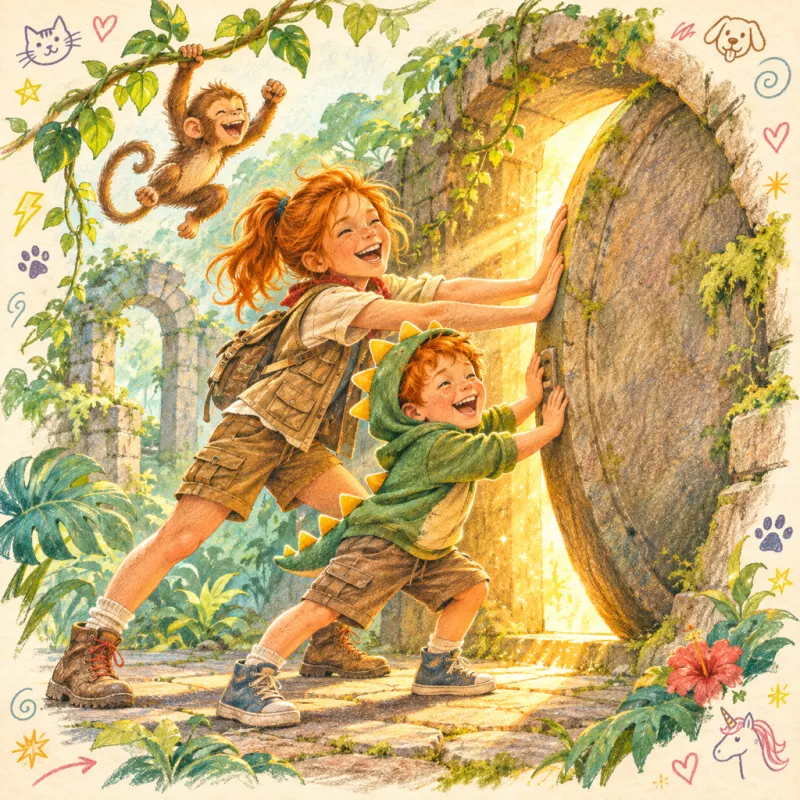
Two heroes have to get through a gate that only opens when they work together. A sibling can appear as a supporting character — just describe them in the wish.
- 1 · Discover
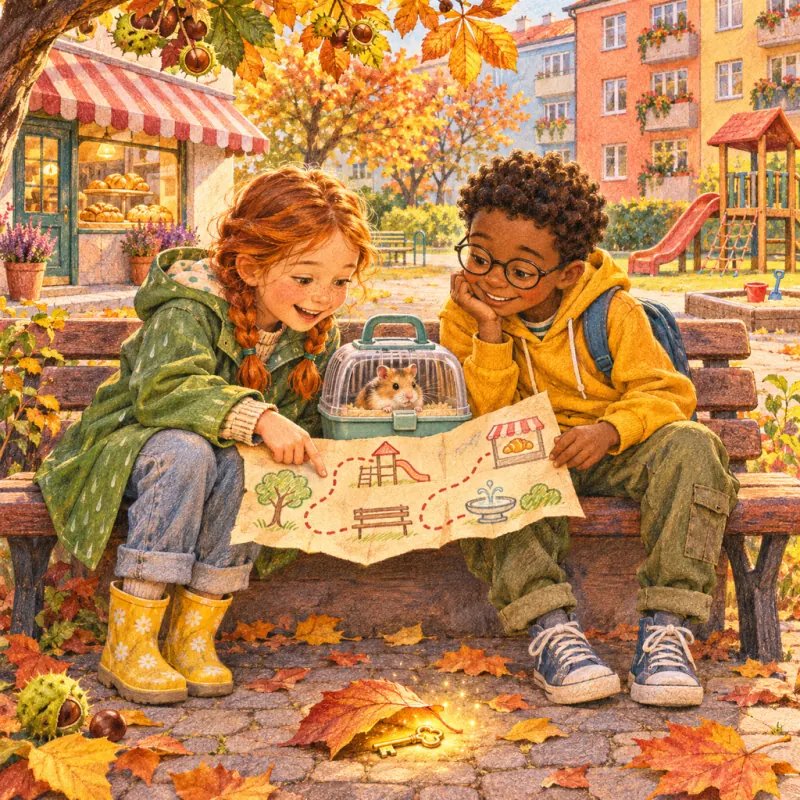
The siblings argue over the map and the gate slams shut. Then they see two elves reach an agreement.
- 2 · Try
The children make up what the heroes say to each other instead of arguing, and try taking turns.
- 3 · Teach
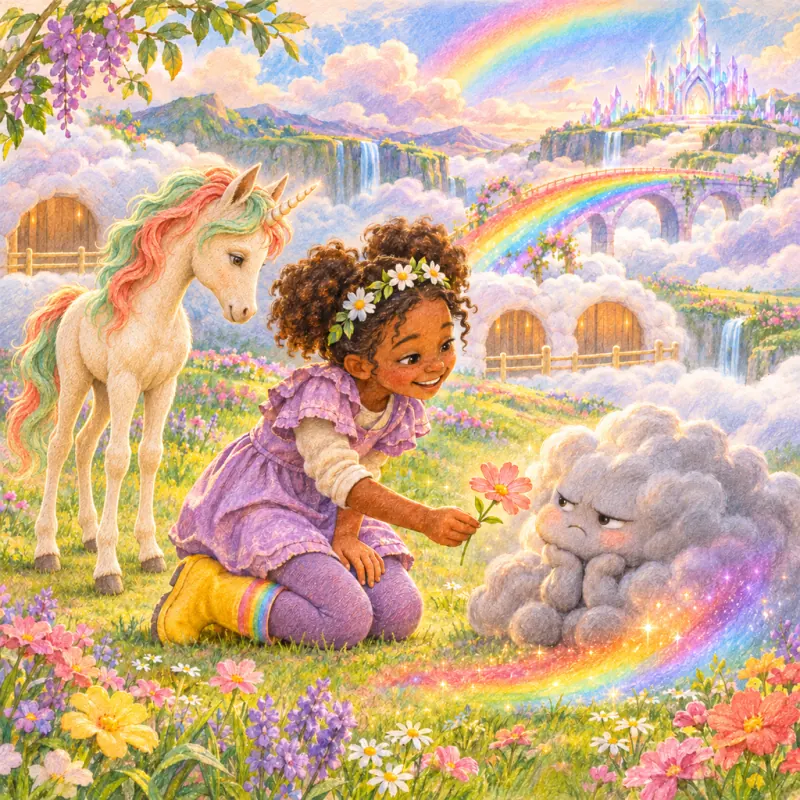
Two little creatures are squabbling — the heroes show them how to reach an agreement.
The last page: an argument over the TV remote — and a deal with a timer.
By age
- Development
- Taking turns and sharing are still being learned; one simple sentence instead of a fight helps.
- In the story
- Taking turns with a sand timer, one sentence instead of a fight.
- Development
- Fairness is a big deal; children tell moral rules (don’t hurt, be fair) apart from agreed customs. Turiel 1983
- In the story
- “I” statements and a simple agreement; fairness is a big deal at this age.
- Development
- Compares themselves a lot with others, including siblings — so we never compare siblings in our stories. Harter 2012
- In the story
- Bigger age gaps, privacy and their own things; a shared plan.
- Development
- A need for privacy and their own decisions; controlling communication was associated with more defiance in adolescents. Van Petegem et al. 2015
- In the story
- Respect for privacy, less refereeing, more negotiating on their own.
What we base this on
The approach
Sibling programmes teach children to play together, settle disputes and handle emotions. It helps when parents don’t compare and explain why they sometimes treat the children differently. That’s why both heroes have an equally important role in the story.
The rating is about the approach, not about our comic — the comic itself has not yet been scientifically tested.
What the research says
The More Fun with Sisters and Brothers programme taught siblings to play together, settle disputes and handle emotions, and evaluated changes in emotion regulation and in the quality of their relationship.
The Siblings Are Special programme works with siblings as a team — as a way of preventing later behaviour problems.
Siblings strongly influence each other in childhood and adolescence; how a parent treats each child also matters.
What we don’t promise on this topic
That siblings will stop arguing. Arguments are normal; the story shows one step for sorting them out fairly.
Key sources
- Kennedy, D. E., & Kramer, L. (2008). Improving emotion regulation and sibling relationship quality: The More Fun With Sisters and Brothers program. Family Relations, 57(5), 567–578. doi.org/10.1111/j.1741-3729.2008.00523.x abstract
- Feinberg, M. E., et al. (2013). Siblings Are Special: Initial test of a new approach for preventing youth behavior problems. Journal of Adolescent Health, 53(2), 166–173. doi.org/10.1016/j.jadohealth.2012.10.004 metadata
- McHale, S. M., Updegraff, K. A., & Whiteman, S. D. (2012). Sibling relationships and influences in childhood and adolescence. Journal of Marriage and Family, 74(5), 913–930. doi.org/10.1111/j.1741-3737.2012.01011.x metadata
- Harter, S. (2012). The construction of the self: Developmental and sociocultural foundations (2nd ed.). metadata
- Turiel, E. (1983). The development of social knowledge: Morality and convention. Cambridge University Press. metadata
- Van Petegem, S., Soenens, B., Vansteenkiste, M., & Beyers, W. (2015). Rebels with a cause? Adolescent defiance from the perspective of reactance theory and self-determination theory. Child Development, 86(3), 903–918. doi.org/10.1111/cdev.12355 abstract
- abstract abstract or full text read
- metadata bibliographic details verified
- institution official institutional document
Who prepared this and when
Written by the Ink & Brave editorial team from our evidence base (sources verified 8 November 2026, last updated 9 November 2026).
If you feel like it
- Don’t compare siblings — not even when praising them.
- You can use the timer from the comic at home too, if the children want to.
When a comic isn’t enough
- The arguments turn into repeated hurting, or one sibling is afraid of the other.
- Talk to a paediatrician or GP, or a child psychologist.
Need help right now? If someone is in danger, call your local emergency number — 112 in the EU, 999 in the UK, 911 in the US and Canada, 000 in Australia. Child and parent helplines by country
Frequently asked questions
Can both siblings be in the comic?
Yes. A sibling can appear as a supporting character — just describe them in the wish.
Won’t one of them end up as ‘the bad one’?
Never. A sibling is never the villain; the problem is the situation, which they solve together.
What if there is a big age gap between them?
The story adapts the roles: the older child might be the captain and the younger one the explorer, for example — both important.
Reading for parents
- Article in preparation Siblings arguing all the time: what helps?
- Article in preparation How do you prepare a child for a new sibling?
Personalised book: Siblings
A personalised book on this topic — a story for €9.90 (1 story · 16 pages) or a whole adventure for €24.90 (3 stories · 48 pages), as a storybook or a comic. A free drawing of the hero first.