What your child practises
Listening to the end, asking “why?” politely, agreeing on something and keeping to it — and knowing when to say “no” (a stranger, someone hurting you).
A rule of the magical world has a reason the hero only discovers by breaking it — a natural consequence, not a punishment. At the end the hero suggests a fair agreement. At least once in the series, the hero rightly says “no” to a stranger.
Five steps your child practises
Listen to the end
Let the other person finish, and look at them.
Repeat what I heard
“I need to put my shoes on because we’re going out.”
Ask “why?” or suggest something
Politely: “Can I finish my drawing first?”
Agree and stick to it
An agreement applies to both sides. Whoever breaks it puts it right.
My “no” counts
When someone hurts me — even an adult — I may say “no” and tell another adult.
How the story shows it
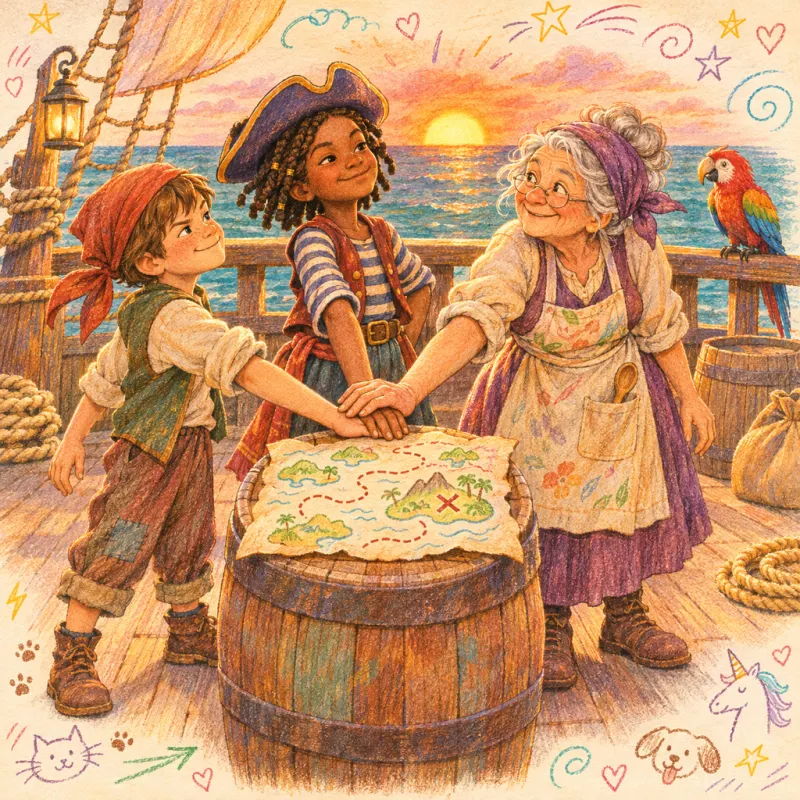
A ship’s captain and crew, a school of magic with rules for spells, a ninja code. Every rule has a reason, which the hero discovers.
- 1 · Discover
The hero breaks a rule that seems silly to them, and trouble follows. They find out why the rule was there.
- 2 · Try
Your child comes up with a fair agreement that the hero proposes to the captain — and keeps.
- 3 · Teach
A new cabin boy doesn’t understand the rules — the hero explains them. And when a stranger tries to lure the cabin boy away, the hero says “no” and goes to their trusted adult.
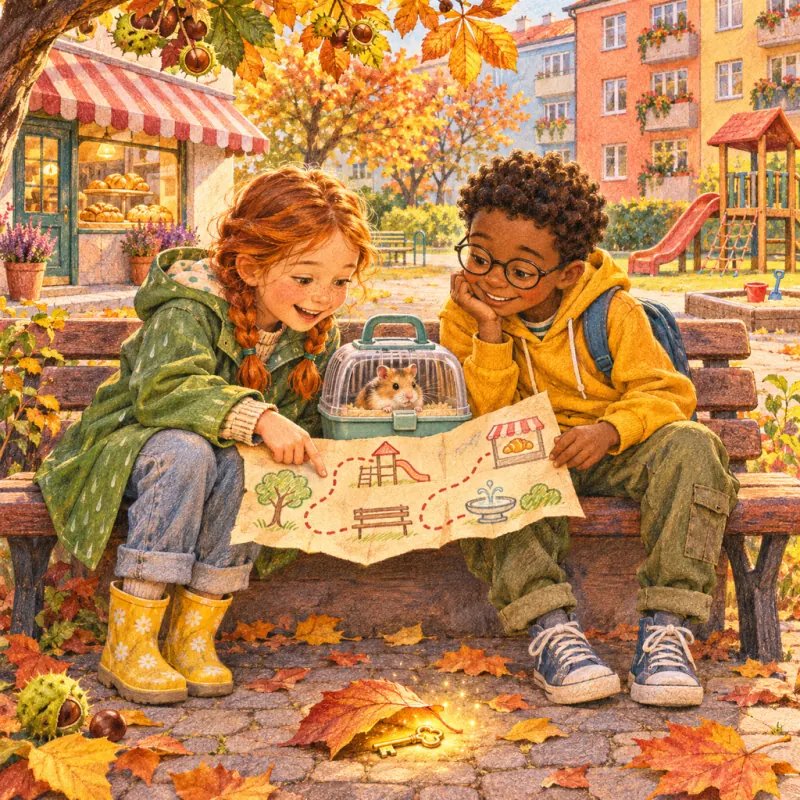
The last page: an agreement with Mum about time at the playground — and the hero keeps it.
By age
- Development
- Already tells moral rules (don’t hurt) apart from agreed customs (tidy up); one rule with a picture and one reason helps. Turiel 1983; Killen & Smetana 2015
- In the story
- Simple rules with a picture and one reason; “first–then”.
- Development
- A strong sense of fairness and rules; the reason for a rule and making amends after breaking it make sense. Turiel 1983
- In the story
- The reason behind a rule, a simple agreement, putting things right after breaking it.
- Development
- Sensitive to control: a controlling tone worsened deeper learning in 11–12-year-olds — so we let the child suggest the agreement. Vansteenkiste et al. 2005
- In the story
- Negotiating and compromise; agreements the children suggest themselves.
- Development
- Controlling communication was associated with more defiance in adolescents — so rules come with an explanation and a choice. Van Petegem et al. 2015
- In the story
- More independence, fewer orders; no lecturing, with respect.
What we base this on
The approach
Warmth combined with a clear rule, a short explanation of the reason and room for the child’s opinion. The goal is “I do it because I understand and agree”, not “because someone is watching”. Research does not support shaming or physical punishment. Safety is part of it: the child knows they may say “no” to anyone who hurts them.
The rating is about the approach, not about our comic — the comic itself has not yet been scientifically tested.
What the research says
Only willing (“committed”) compliance — “I do it because I agree” — predicted later internalisation of rules; compliance only under supervision did not.
Warmth and an authoritative style (warmth plus clear rules) were linked to fewer behaviour problems; harsh and psychological control to more. The effects are small and run both ways.
Spanking was linked to worse outcomes in 13 of 17 areas studied.
School programmes improved children’s knowledge about protection from sexual abuse; their effect on disclosure remains uncertain, and only 2 studies looked at protective behaviour.
The distinction between authoritative (warmth and rules), authoritarian and permissive parenting comes from Diana Baumrind’s work.
What we don’t promise on this topic
That your child will “obey”. The aim is agreement, not blind obedience — the story never teaches that adults are always right.
Key sources
- Kochanska, G., Aksan, N., & Koenig, A. L. (1995). A longitudinal study of the roots of preschoolers' conscience: Committed compliance and emerging internalization. Child Development, 66(6), 1752. doi.org/10.2307/1131908 abstract
- Pinquart, M. (2017). Associations of parenting dimensions and styles with externalizing problems of children and adolescents: An updated meta-analysis. Developmental Psychology, 53(5), 873–932. doi.org/10.1037/dev0000295 abstract
- Gershoff, E. T., & Grogan-Kaylor, A. (2016). Spanking and child outcomes: Old controversies and new meta-analyses. Journal of Family Psychology, 30(4), 453–469. doi.org/10.1037/fam0000191 abstract
- Walsh, K., Zwi, K., Woolfenden, S., & Shlonsky, A. (2015). School-based education programmes for the prevention of child sexual abuse. Cochrane Database of Systematic Reviews, 2015(4), CD004380. doi.org/10.1002/14651858.CD004380.pub3 abstract
- Baumrind, D. (1966). Effects of authoritative parental control on child behavior. Child Development, 37(4), 887. doi.org/10.2307/1126611 metadata
- Baumrind, D. (1971). Current patterns of parental authority. Developmental Psychology, 4(1, Pt. 2), 1–103. doi.org/10.1037/h0030372 metadata
- Turiel, E. (1983). The development of social knowledge: Morality and convention. Cambridge University Press. metadata
- Killen, M., & Smetana, J. G. (2015). Origins and development of morality. In Handbook of Child Psychology and Developmental Science (pp. 1–49). Wiley. doi.org/10.1002/9781118963418.childpsy317 metadata
- Vansteenkiste, M., Simons, J., Lens, W., Soenens, B., & Matos, L. (2005). Examining the motivational impact of intrinsic versus extrinsic goal framing and autonomy-supportive versus internally controlling communication style. Child Development, 76(2), 483–501. doi.org/10.1111/j.1467-8624.2005.00858.x abstract
- Van Petegem, S., Soenens, B., Vansteenkiste, M., & Beyers, W. (2015). Rebels with a cause? Adolescent defiance from the perspective of reactance theory and self-determination theory. Child Development, 86(3), 903–918. doi.org/10.1111/cdev.12355 abstract
- abstract abstract or full text read
- metadata bibliographic details verified
- institution official institutional document
Who prepared this and when
Written by the Ink & Brave editorial team from our evidence base (sources verified 8 November 2026, last updated 9 November 2026).
If you feel like it
- If you like, write or draw one family agreement with your child — just like the hero in the comic.
- Explain a rule once and briefly; after that, a reminder of the agreement is enough.
When a comic isn’t enough
- If conflicts at home are very frequent and exhausting for the whole family, talk to a paediatrician or GP, or a family support service.
Need help right now? If someone is in danger, call your local emergency number — 112 in the EU, 999 in the UK, 911 in the US and Canada, 000 in Australia. Child and parent helplines by country
Frequently asked questions
Aren’t you teaching children to disobey?
We teach listening, reaching agreements and keeping your word. And also that a child may say “no” to anyone who hurts them — that matters for their safety.
Why not just plain obedience?
An agreement a child understands is easier to stick to, even when no one is watching. That’s why the story explains the reasons behind the rules.
Will my child listen to me afterwards?
We don’t promise that. The comic shows your child the steps and lets them practise them in the story.
Reading for parents
- Article in preparation How do you get your child to listen — without shouting or punishment?
Personalised book: Agreements
A personalised book on this topic — a story for €9.90 (1 story · 16 pages) or a whole adventure for €24.90 (3 stories · 48 pages), as a storybook or a comic. A free drawing of the hero first.