
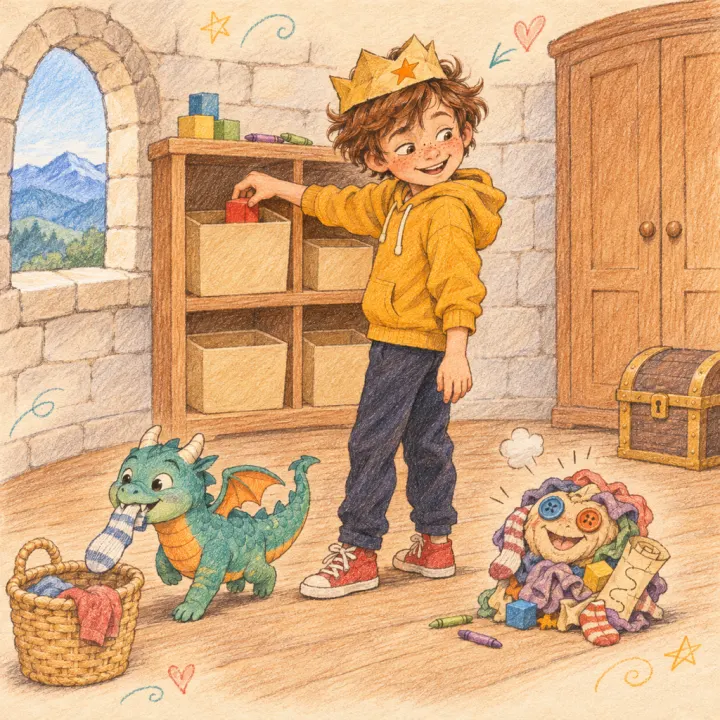
What your child practises
Breaking a big task into small pieces and getting started; putting things back right after playing.
The mess has a body — a troll that shrinks with every item put back. At the end the hero says the step in plain words (“Blocks first, then cars.”) and invents a quick tidy-up game in a room that looks like a real one. No scare tactics and no sweets as a reward.
Five steps your child practises
Break it into pieces
Not “tidy your room”, but “blocks first”.
Start with the easiest
The first piece has to be simple — it gets things going.
First–then
“First the blocks, then the cars, then the books.”
A game or a timer
A tidy-up song, a race against the sand timer.
Check that it’s done
Look around — and enjoy it.
How the story shows it
In the child’s world, the mess has a body — a sock troll, a fog that swallows things, a black hole in the bedroom. It shrinks with every thing put back in its place.
- 1 · Discover
The hero loses the expedition map in the mess. The troll grows. The hero discovers that it shrinks whenever something goes back in its place.
- 2 · Try
Your child invents a “quick tidy-up game” and the order of the pieces; the hero tries it.
- 3 · Teach
A friend has an even bigger troll in their cave — the hero shows them how to tackle it bit by bit.
The last page: the bedroom before dinner — “first the blocks, then the cars”.
By age
- Development
- Can manage one concrete thing and one step at a time; planning and stopping are still developing. Diamond & Lee 2011
- In the story
- One thing at a time, a tidy-up song, pictures showing where the toys live.
- Development
- Starting to manage a sequence of steps; games and a visible plan help.
- In the story
- The order of steps and a timer; independence with a little help.
- Development
- Sensitive to “you must” and to rewards — rewards promised in advance undermine interest more in children than in adults. Deci et al. 1999; Vansteenkiste et al. 2005
- In the story
- Their own system and plan; tidying up as part of an agreement.
- Development
- A need for privacy and their own rules; controlling communication was associated with more defiance in adolescents. Van Petegem et al. 2015
- In the story
- Privacy in their room and their own rules; no lecturing.
What we base this on
The approach
Small steps, a regular order, and support for independence and choice rather than orders; no material rewards promised in advance, which can weaken a child’s own motivation. Household chores are linked to independence — but these are associations from observational studies, not proof of cause.
The rating is about the approach, not about our comic — the comic itself has not yet been scientifically tested.
What the research says
Material rewards promised in advance reduced voluntary engagement in an enjoyable activity (d −0.28 to −0.40), more in children than in adults; positive verbal feedback increased it (d = 0.33). Effects depended on the type of reward and how motivation was measured.
Toddlers who were given a material reward for helping later helped less than children without a reward.
Supporting autonomy — choice and explanation rather than orders — is at the core of self-determination theory in parenting.
Chores are linked to children’s independence and executive functions — these are observational associations, not proof of cause.
What we don’t promise on this topic
That your child will start tidying up on their own. The evidence for this approach is weak to moderate (mostly observational studies).
Key sources
- Deci, E. L., Koestner, R., & Ryan, R. M. (1999). A meta-analytic review of experiments examining the effects of extrinsic rewards on intrinsic motivation. Psychological Bulletin, 125(6), 627–668. doi.org/10.1037/0033-2909.125.6.627 abstract
- Joussemet, M., Landry, R., & Koestner, R. (2008). A self-determination theory perspective on parenting. Canadian Psychology, 49(3), 194–200. doi.org/10.1037/a0012754 metadata
- White, E. M., DeBoer, M. D., & Scharf, R. J. (2019). Associations between household chores and childhood self-competency. Journal of Developmental & Behavioral Pediatrics, 40(3), 176–182. doi.org/10.1097/DBP.0000000000000637 metadata
- Tepper, D. L., Howell, T. J., & Bennett, P. C. (2022). Executive functions and household chores: Does engagement in chores predict children's cognition? Australian Occupational Therapy Journal, 69(5), 585–598. doi.org/10.1111/1440-1630.12822 metadata
- Warneken, F., & Tomasello, M. (2008). Extrinsic rewards undermine altruistic tendencies in 20-month-olds. Developmental Psychology, 44(6), 1785–1788. doi.org/10.1037/a0013860 abstract
- Diamond, A., & Lee, K. (2011). Interventions shown to aid executive function development in children 4 to 12 years old. Science, 333(6045), 959–964. doi.org/10.1126/science.1204529 metadata
- Vansteenkiste, M., Simons, J., Lens, W., Soenens, B., & Matos, L. (2005). Examining the motivational impact of intrinsic versus extrinsic goal framing and autonomy-supportive versus internally controlling communication style. Child Development, 76(2), 483–501. doi.org/10.1111/j.1467-8624.2005.00858.x abstract
- Van Petegem, S., Soenens, B., Vansteenkiste, M., & Beyers, W. (2015). Rebels with a cause? Adolescent defiance from the perspective of reactance theory and self-determination theory. Child Development, 86(3), 903–918. doi.org/10.1111/cdev.12355 abstract
- abstract abstract or full text read
- metadata bibliographic details verified
- institution official institutional document
Who prepared this and when
Written by the Ink & Brave editorial team from our evidence base (sources verified 8 November 2026, last updated 9 November 2026).
If you feel like it
- If you like, play the song your child made up in the comic while tidying.
- Praise a specific piece: “The blocks are all put away.”
When a comic isn’t enough
- If your child generally finds it very hard to start and finish tasks, at school too, talk to the school psychologist or counsellor, or a paediatrician or GP.
Need help right now? If someone is in danger, call your local emergency number — 112 in the EU, 999 in the UK, 911 in the US and Canada, 000 in Australia. Child and parent helplines by country
Frequently asked questions
Will my child then tidy up on their own?
We don’t promise that. The comic shows your child how to break a big job into pieces and lets them try it out in the story.
Isn’t it just more nagging?
No. Nobody shouts in the story; the hero works out for themselves why tidying is worth it and invents their own game.
What age is it for?
From age 4 with a parent; it suits children aged 4–9 best.
Reading for parents
- Article in preparation Should children be rewarded for tidying up?
Personalised book: Tidying up
A personalised book on this topic — a story for €9.90 (1 story · 16 pages) or a whole adventure for €24.90 (3 stories · 48 pages), as a storybook or a comic. A free drawing of the hero first.