What your child practises
Recognise pressure, secrecy and crossed boundaries, end contact and go to a trusted adult — even after sending something.
The story gives your child words and a step to try in an invented situation. But safety mainly rests with services and adults, not the child.
Five steps your child practises
Notice the warning signs
Over-the-top attention and gifts (in-game currency too), “this is just between us”, pressure to move to a private chat, asking for a photo or to meet. A private chat or a gift on its own proves nothing — the warning sign is pressure and enforced secrecy.
Say “I don’t want to”
“No” counts online too. I can say “I need to ask an adult” — and I don’t have to explain.
End it and block
Stop replying, block, report on the platform. Don’t delete the messages — they can help adults.
Tell an adult
“I need help with something online.” It’s enough that it feels weird — no need to collect proof. If one adult doesn’t help, I tell another.
It’s not your fault
Even if I’ve already replied, sent something or paid, I still deserve help. The blame lies with the person causing harm.
How the story shows it
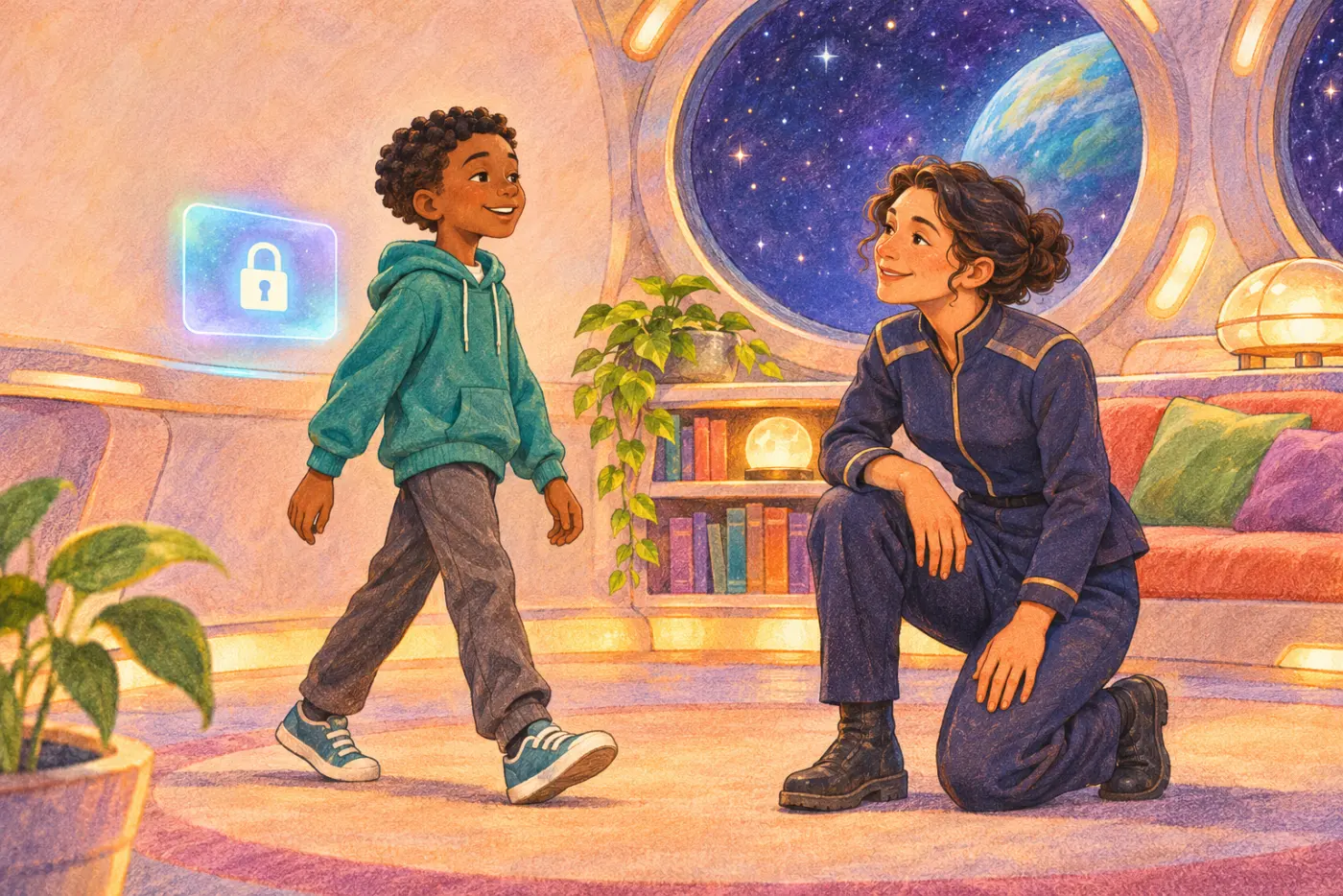
World metaphors (a secret channel on the space station, sealed letters at the Academy) and always a real-life step. Difficult things happen to a made-up character — your child is never portrayed as a victim; the hero recognises pressure, leaves and goes to an adult, or helps a made-up friend.
- 1 · Discover
9–11: a friendly pilot from another ship sends gifts and wants “a secret channel, don’t tell the commander”. The hero doesn’t know exactly what’s wrong — only that a secret from adults feels weird. That’s enough. 12–14: pressure and flattery; the hero stops and tells.
- 2 · Try
In the brief your child picks what the hero does (not reply, block, tell…) and practises the line “I need help with something online.” They can skip it — we only rehearse an invented situation.
- 3 · Teach
The hero helps a younger cadet with a scam or a secret; for 12–14 the hero supports a made-up friend who is being blackmailed — “don’t pay, don’t send anything, don’t delete it, let’s go to someone”.
The last page of the book: a real phone and chat — “I’ll close it, block them and tell Mum: I need help with something online.”
Is it happening now?
- Don’t delete messages or the profile, don’t pay and don’t send anything else.
- Tell your child: “I’m glad you told me. It’s not your fault.” Don’t take their phone away as a punishment.
- Report it and get advice — numbers for your country are below under “When a comic isn’t enough”.
By age
- Development
- Under 9: only the body, secrets and trusted adults. NSPCC 2026; UKCIS 2020
- In the story
- Only “my body belongs to me”, surprises vs bad secrets, “knowing someone online isn’t like in real life” and my trusted adults. This part is still in preparation.
- Development
- Children block and report more often than they go to an adult, so we also rehearse the way to an adult. Thorn 2021
- In the story
- Pressure to keep secrets and private chats, gifts in games, fake profiles, asking before sharing a friend’s photo, code scams, “block, report and tell an adult”. No explicit naming of sexual content.
- Development
- Sensitive windows for social media: girls 11–13, boys 14–15; average associations are small. Orben et al. 2022; Orben & Przybylski 2019; Valkenburg et al. 2022
- In the story
- Also comparison and social media pressure, pressure to share intimate images, image-based blackmail (including AI fakes), help even after sending or paying, digital footprint. Never an intimate image, never a romanticised relationship with an adult.
What we base this on
The approach
Rehearse concrete steps (recognise → refuse → end → tell), repeatedly and without scaring; a realistic picture of who offends; “it’s not your fault”; a calm adult who doesn’t punish or take the phone away.
The rating is about the approach, not about our comic — the comic itself has not yet been scientifically tested.
What the research says
The idea of a stranger who lures children with tricks is mostly inaccurate; more often an adult gradually gains a teenager’s trust and manipulates them.
Perpetrators of online sexual abuse were mostly partners, friends and acquaintances, not online strangers.
Active, skills-based lessons with enough sessions work; scaring and lectures alone do not.
Of those who paid in financial sextortion, 27% received further demands.
School prevention programmes mainly improve knowledge; three studies found no difference in children’s anxiety or fear.
What we don’t promise on this topic
That the comic prevents abuse or replaces conversation and settings. Our comic’s effect is untested; the topic is still in preparation.
Key sources
- Wolak, J., Finkelhor, D., Mitchell, K. J., & Ybarra, M. L. (2008). Online "predators" and their victims: Myths, realities, and implications for prevention and treatment. American Psychologist, 63(2), 111–128. doi.org/10.1037/0003-066X.63.2.111 abstract
- Finkelhor, D., Turner, H. A., & Colburn, D. (2022). Prevalence of online sexual offenses against children in the US. JAMA Network Open, 5(10), e2234471. doi.org/10.1001/jamanetworkopen.2022.34471 abstract
- Finkelhor, D., Walsh, K., Jones, L., Mitchell, K., & Collier, A. (2021). Youth internet safety education: Aligning programs with the evidence base. Trauma, Violence, & Abuse, 22(5), 1233–1247. doi.org/10.1177/1524838020916257 abstract
- Jones, L. M., Mitchell, K. J., & Walsh, W. A. (2014). A systematic review of effective youth prevention education: Implications for internet safety education. Crimes against Children Research Center. www.ojp.gov/ncjrs/virtual-library/abstracts/systematic-review-effective-youth-prevention-education-implications institution
- Whittle, H., Hamilton-Giachritsis, C., Beech, A., & Collings, G. (2013). A review of online grooming: Characteristics and concerns. Aggression and Violent Behavior, 18(1), 62–70. doi.org/10.1016/j.avb.2012.09.003 abstract
- Thorn & NCMEC (2024). Trends in Financial Sextortion: An investigation of sextortion reports in NCMEC CyberTipline data. info.thorn.org/hubfs/Research/Thorn_TrendsInFinancialSextortion_June2024.pdf institution
- Thorn & Benenson Strategy Group (2021). Responding to Online Threats: Minors' Perspectives on Disclosing, Reporting, and Blocking. info.thorn.org/hubfs/Research/Responding%20to%20Online%20Threats_2021-Full-Report.pdf institution
- Lahtinen, H.-M., Laitila, A., Korkman, J., & Ellonen, N. (2018). Children's disclosures of sexual abuse in a population-based sample. Child Abuse & Neglect, 76, 84–94. doi.org/10.1016/j.chiabu.2017.10.011 abstract
- Walsh, K., Zwi, K., Woolfenden, S., & Shlonsky, A. (2015). School-based education programmes for the prevention of child sexual abuse. Cochrane Database of Systematic Reviews, 2015(4), CD004380. doi.org/10.1002/14651858.CD004380.pub3 abstract
- Orben, A., & Przybylski, A. K. (2019). The association between adolescent well-being and digital technology use. Nature Human Behaviour, 3(2), 173–182. doi.org/10.1038/s41562-018-0506-1 abstract
- Valkenburg, P. M., Meier, A., & Beyens, I. (2022). Social media use and its impact on adolescent mental health: An umbrella review of the evidence. Current Opinion in Psychology, 44, 58–68. doi.org/10.1016/j.copsyc.2021.08.017 abstract
- UKCIS (2020). Education for a Connected World — 2020 edition. www.gov.uk/government/publications/education-for-a-connected-world institution
- UKCIS (2024). Sharing nudes and semi-nudes: advice for education settings (aktualizované 11. 3. 2024). www.gov.uk/government/publications/sharing-nudes-and-semi-nudes-advice-for-education-settings-working-with-children-and-young-people institution
- NSPCC (2026). Talk PANTS. www.nspcc.org.uk/advice-for-families/pants-underwear-rule/ institution
- NCMEC. Sextortion. www.ncmec.org/theissues/sextortion institution
- Orben, A., Przybylski, A. K., Blakemore, S.-J., & Kievit, R. A. (2022). Windows of developmental sensitivity to social media. Nature Communications, 13, 1649. doi.org/10.1038/s41467-022-29296-3 abstract
- abstract abstract or full text read
- metadata bibliographic details verified
- institution official institutional document
Who prepared this and when
Written by the Ink & Brave editorial team from our evidence base (sources verified 8 November 2026, last updated 9 November 2026).
If you feel like it
- Ask after reading: “What would you do in the hero’s place?”
- If your child tells you something: “Thank you for telling me. It’s not your fault. We’ll sort this out together.”
When a comic isn’t enough
- If it’s happening now: don’t delete anything, don’t pay, don’t confront. Tell your child: “I’m glad you told me. It’s not your fault. We’ll sort this out together.”
- Report it (police and the reporting service for your country, below) and get advice from a helpline — as a parent too.
- Never download, copy or forward an intimate image — not even as evidence.
Choose your country and we’ll show the right numbers. If someone is in danger, call the emergency number now: 112 in the EU, 999 in the UK, 911 in the US and Canada, 000 in Australia.
Another country
We pick help by the country you are in, not by the website’s language. Conditions, call costs and opening hours are listed by each service. Checked 9 November 2026. Somewhere else? Child Helpline International (child helplines by country). Helplines in every country
Frequently asked questions
Won’t this frighten my child?
The story is calm and hopeful: no scary monsters and no scary statistics. The hero doesn’t have to “uncover” anything — it’s enough that something feels weird, and the adult always believes and helps. In the three school-programme studies reviewed, no difference in children’s average anxiety or fear was found; we have yet to check in a pilot that our comic is appropriate.
Will you show anything sexual?
No. No sexual scenes, intimate images or explicit messages. The version for ages 12–14 also names pressure to share intimate images and blackmail in age-appropriate language — no pictures, only “a photo you don’t want to send”.
Why not “stranger danger”?
Most online abuse comes from someone who acts like a friend or whom the child knows, and it relies on secrecy and isolation. So we teach recognising pressure, secrecy and crossed boundaries.
What if my child has already sent something?
They still deserve help. Don’t delete anything, don’t pay, end contact, report it and get advice from a helpline. Tell your child the blame lies with the person causing harm.
Does this replace parental controls?
No. The comic doesn’t replace conversation, safety settings or professional help — it’s a reason to start that conversation. Parental controls alone aren’t enough, which is why prevention also builds children’s skills.
Reading for parents
Personalised book: Safe online (coming soon)
The ‘Safe Online’ story is in preparation and isn’t for sale yet. If you’d like to know when it’s ready, email us — we’ll use your email for that one message only.